How a 45-year-old Lahore business owner rebuilt his smile in three visits — and gave up the cigarettes
Mr. Usman came in for cosmetic reasons. He wanted a cleaner smile before his daughter's wedding, four months out. We found more than a colour problem — early gum disease, mild bone loss, and a twenty-a-day habit that was actively driving the picture. The honest plan was three visits: deep scaling first, a real conversation about cigarettes, and whitening only at the end. This is the full story of how that played out.
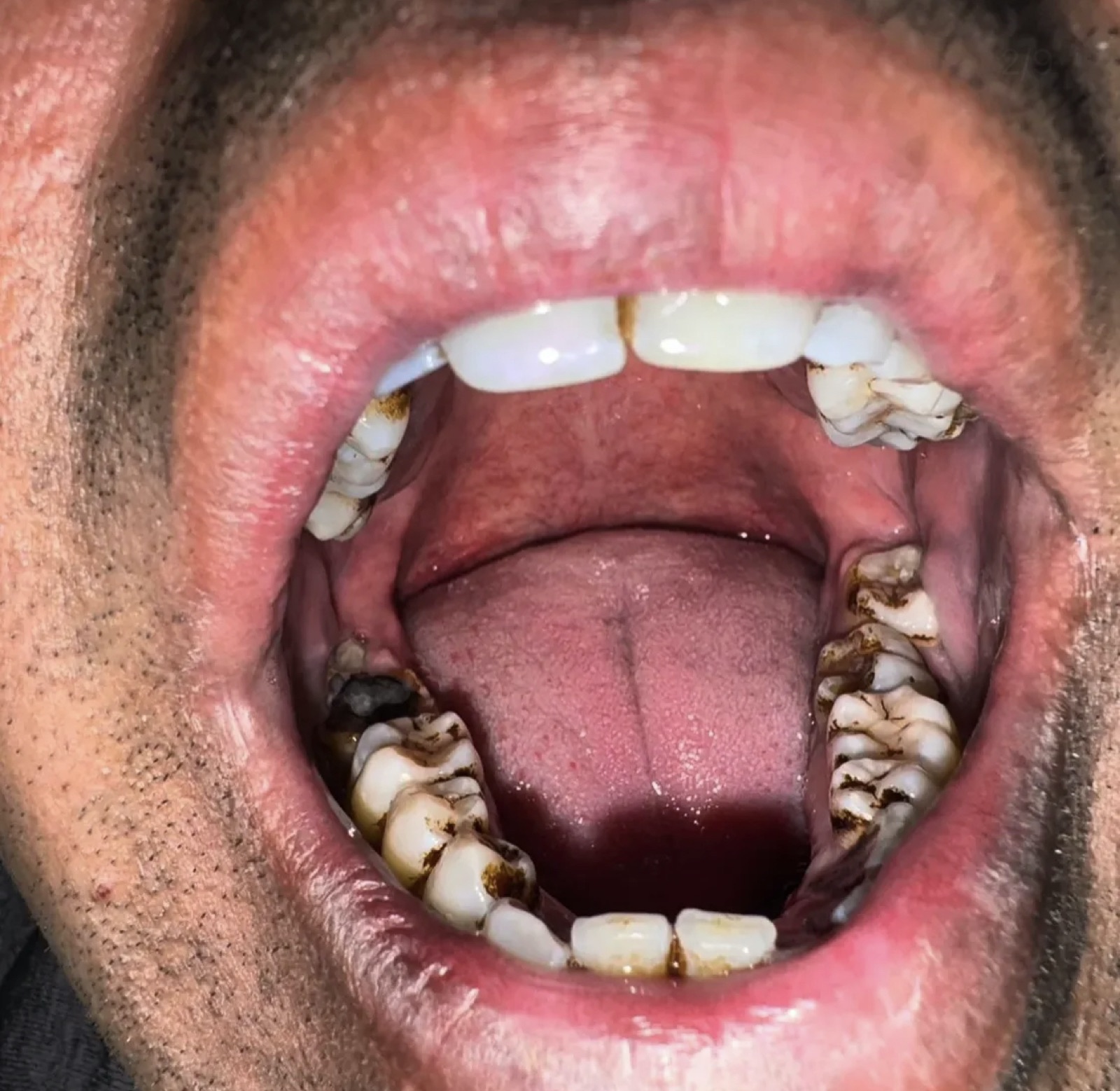 Before
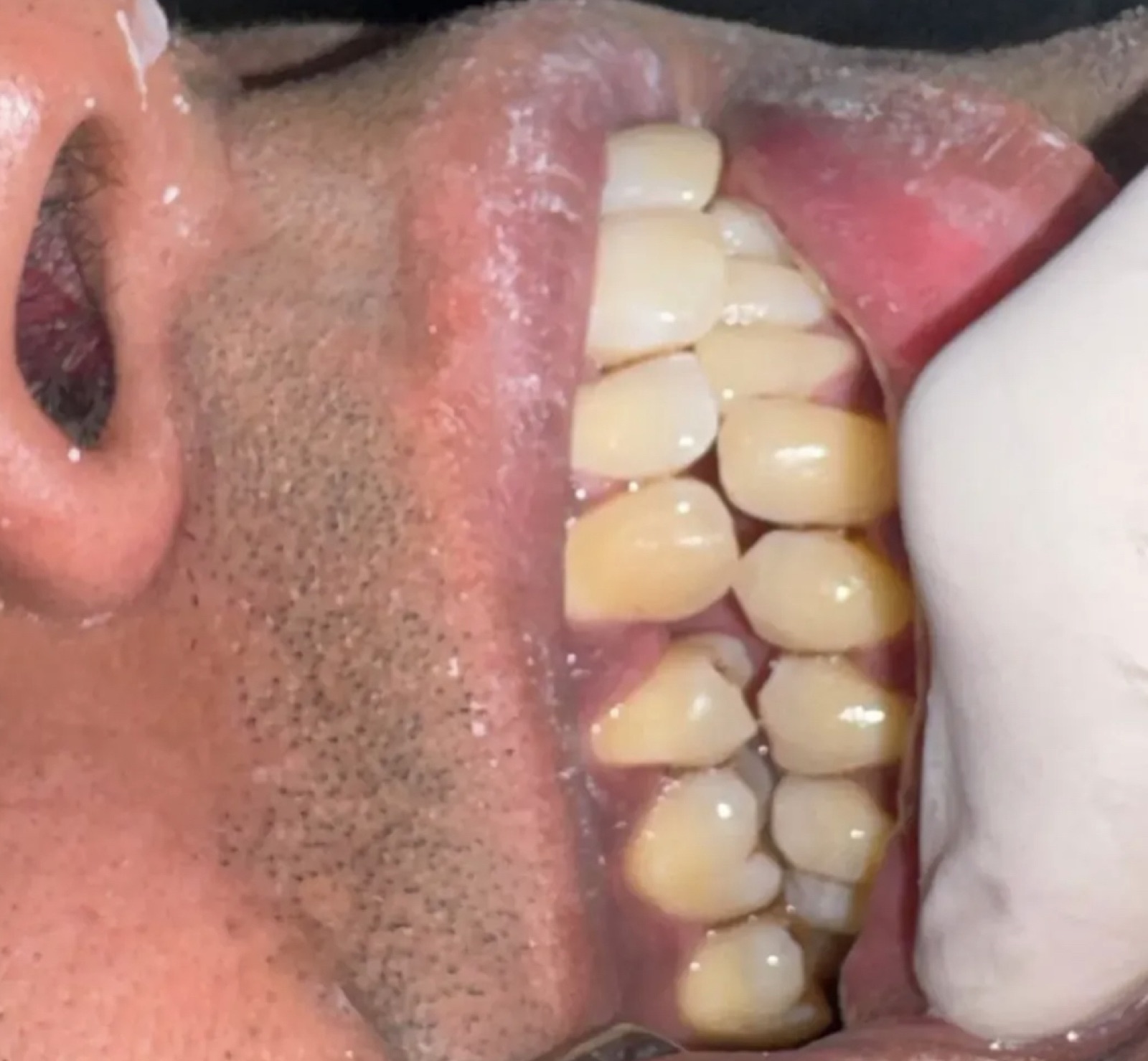 After
AfterHe came in for the colour. The cigarettes were the real conversation.
A staged plan only works if the patient is honest about the cause. Mr. Usman expected to be lectured about smoking. He was not. We laid out the timeline, in plain numbers, and he made his own decision.
Mr. Usman is forty-five. He runs a small import business out of an office in central Lahore — the kind of high-stress, multi-meeting day where putting down a teacup and a cigarette is harder than it sounds in the abstract. One full pack of cigarettes a day for more than twenty years. Five to seven cups of strong, sweet tea a day, mostly in client meetings. He brushes twice a day, like most people, and had not seen a dentist for routine work for several years.
What brought him in was a cosmetic worry. His daughter's wedding was four months out. He had stopped smiling in family photographs because of the colour of his teeth. His phrasing on the day was modest — he wanted “a cleaner smile” — and he was prepared to pay for whitening to get it.
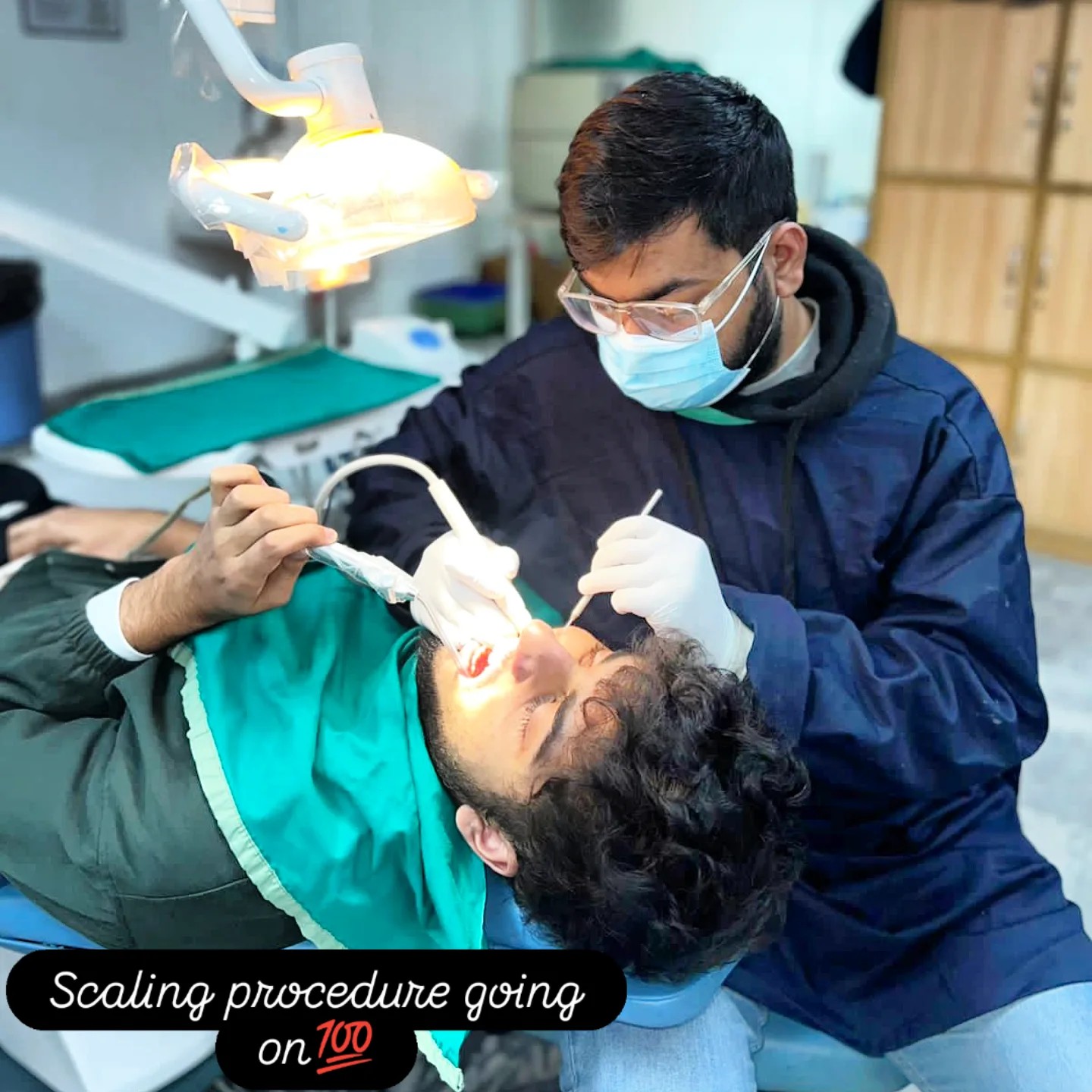
The first appointment ran an hour. Six standardised photographs, a six-point pocket chart around every tooth, a full radiographic series. Then we sat back and walked through what we were seeing, in plain English, on the screen.
The good news: no cavities, no decay under the stain, the enamel underneath was intact.The harder news was on the X-rays — about ten to fifteen percent horizontal bone loss across the molars. Mild, but there. Bleeding-on-probing was registering in five of his six sextants of mouth, even though smoking was almost certainly suppressing the actual signal. The diagnosis was Stage I periodontitis, accelerated by the smoking. This was not just a stain problem. It was an early gum disease problem layered under a heavy stain problem, and the cigarettes were actively driving both.
The cosmetic work he wanted could happen — but it could not come first. Bleaching inflamed gum tissue is needlessly painful and produces an unstable result that drifts back as the smoking continues. The staged plan was: clean and stabilise the gum first across two visits one week apart, take a four-week pause for the gum to heal and for him to address the cigarettes, then proceed with whitening only if the gum tissue had stabilised. We told him plainly that without the smoking coming down, the result would hold for twelve months at most.
We did not lecture. We laid out the timeline. He took it in, asked the right questions, and asked whether we could coordinate with his GP for a nicotine-replacement programme. We could, and we did. He signed the staged plan that afternoon and booked the first deep-scaling visit for the following week.
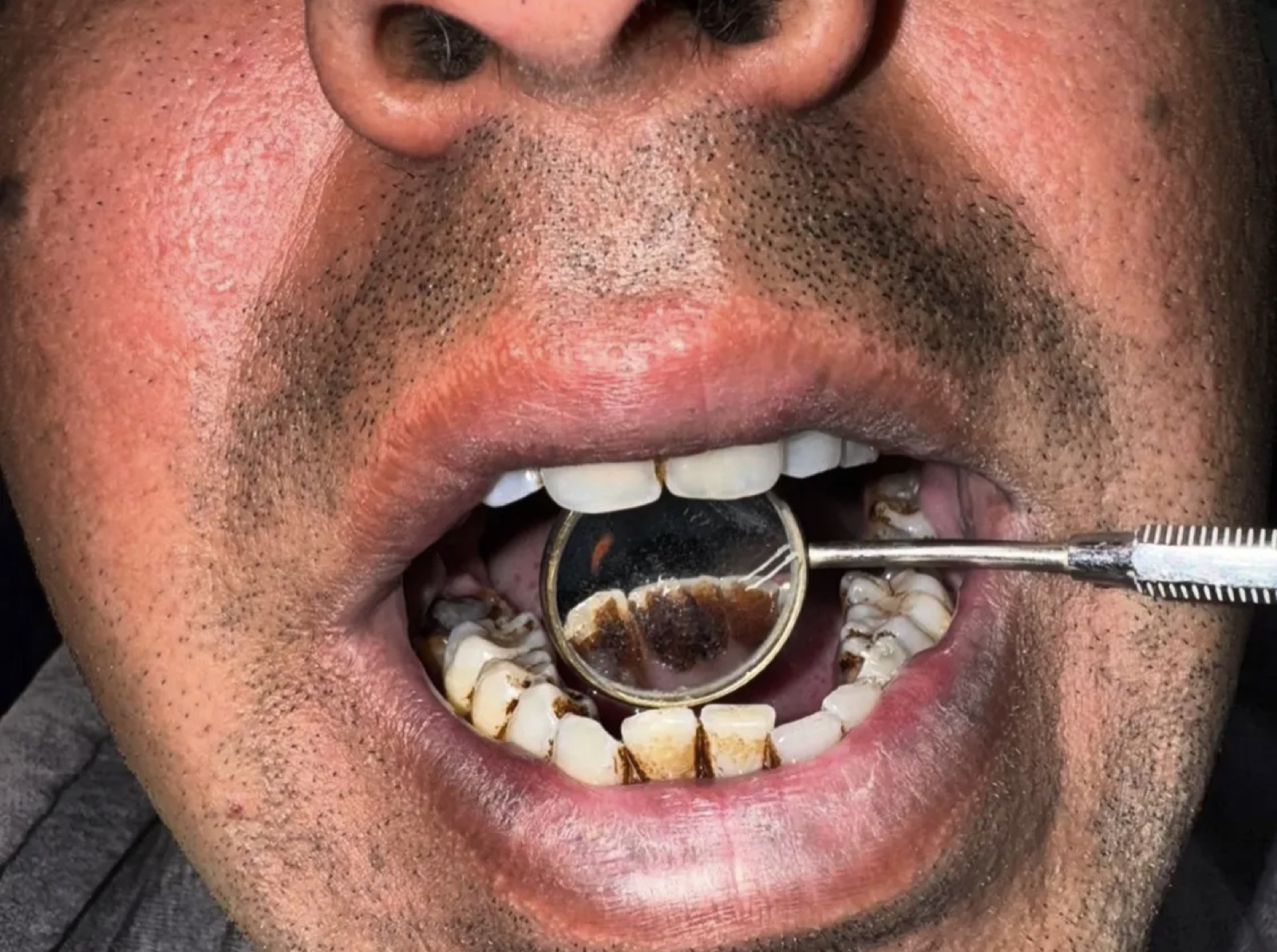
Four findings — explained honestly.
The cosmetic problem is the obvious one. Two of the four findings below are the ones that turned this case from cosmetic into clinical. We do not minimise them, and we do not dramatise them.
Heavy nicotine + tannin staining
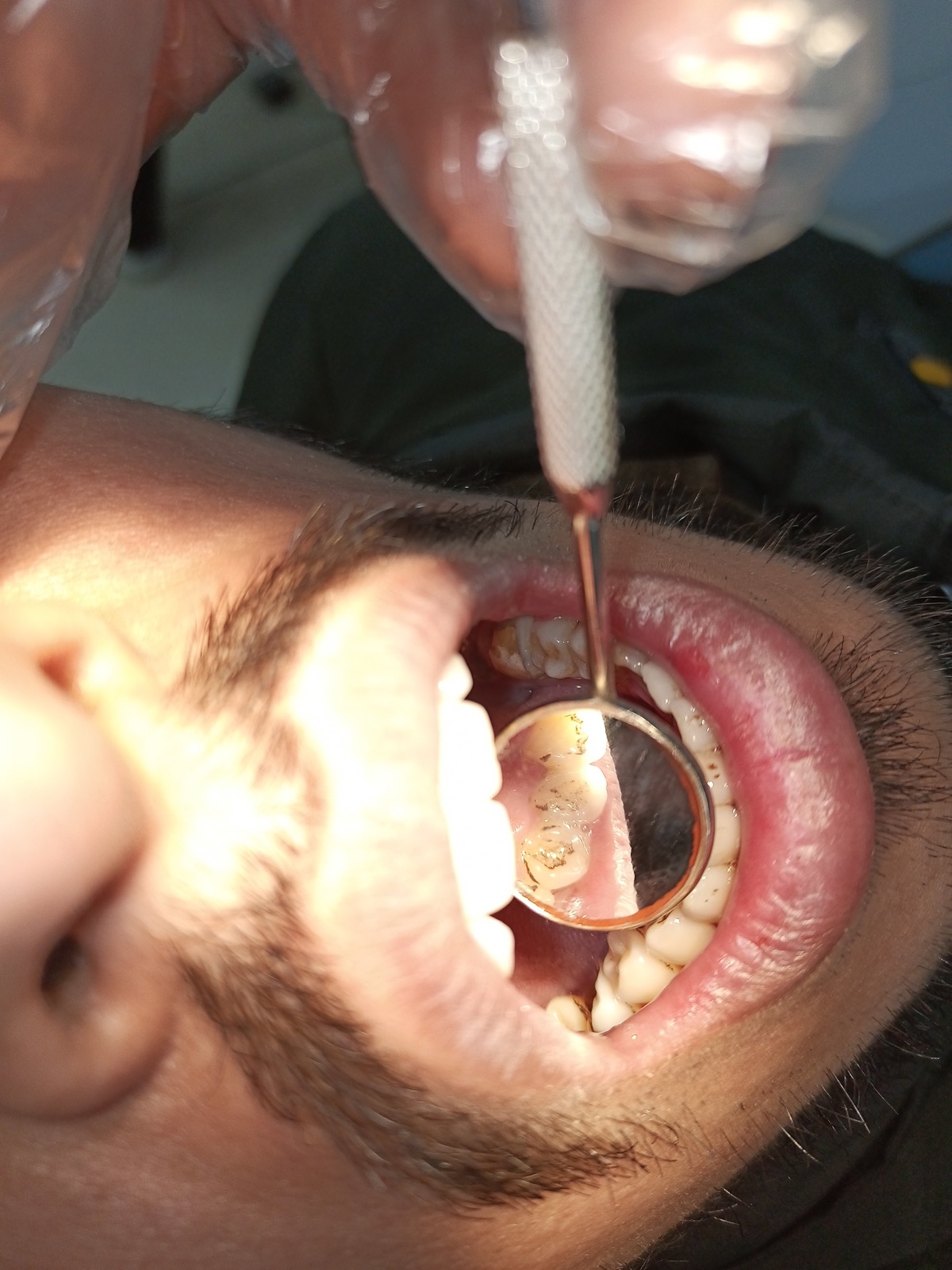
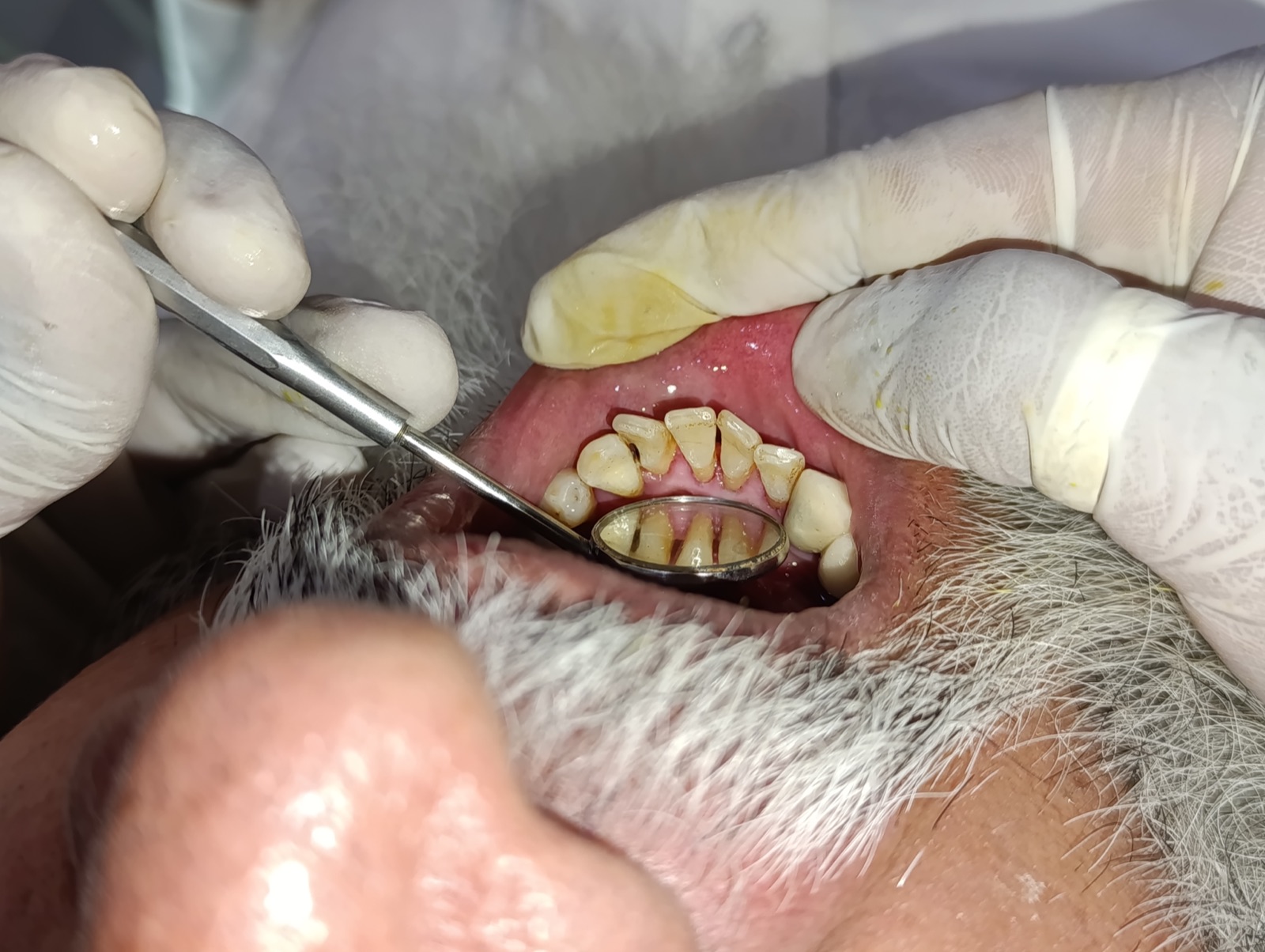
The most visible problem, and not the most serious one. Mr. Usman had a generalised band of dark, almost black extrinsic stain across the labial and lingual surfaces, denser still on the lower anteriors. The colour was a mix — nicotine from twenty cigarettes a day produces a brown-to-black film, and tannins from five-to-seven cups of tea a day add their own warm pigment on top. The two combine into a stain that brushing cannot lift. The good news, on day one, was that the enamel underneath was intact. The colour was a layer; the tooth was clean underneath.
Mild bone loss on X-ray
This was the finding that turned the case from cosmetic into clinical. The bitewings showed about ten to fifteen percent horizontal bone loss across the molars — not catastrophic, but unmistakable. In plain terms: the bone that holds your teeth has started to recede at the back. The diagnosis was Stage I periodontitis, which is the earliest formal stage of gum disease. At Stage I, with smoking active, the trajectory is not stable. The good news is that Stage I is exactly where non-surgical treatment is most effective. The harder news is that without the smoking coming down, that effectiveness is short-lived.
Generalised gum inflammation, accelerated by smoking
Bleeding-on-probing in five of six sextants of his mouth. Smoking complicates the picture in a particular way: it suppresses the gum's normal bleeding response. That means the inflammation we measured was almost certainly under-reported by the test. A gum that should be bleeding to flag a problem stops doing so under nicotine, and the disease quietly progresses without the warning signal. We told him this directly on day one — the absence of bleeding in a smoker is not the absence of disease. It is the warning system being switched off.
No cavities under the stain
A separate piece of good news worth recording. Every chewing surface was checked. Every tooth was X-rayed for hidden decay under the stain layer. There were none. No fillings needed, no root canals, no crowns. The work to do here is at the gum line and on the surface of the tooth, not inside it. That meant the staged plan — clean first, change behaviour, whiten last — could focus entirely on the gum and the colour, with no detours into restorative work.
Four steps. Across three visits and roughly five weeks.
The pacing was deliberate. The four-week pause between the last scaling visit and the whitening visit was the most important decision in the whole file. Every step was explained before it happened.
Examination, charting + the cigarettes conversation
Six standardised photographs. Six-point chart around every tooth. A full radiographic series. Then the harder part — a long, calm conversation about smoking. We mapped the cigarettes against the bone-loss image on the screen and laid out a four-week target for him to reduce or stop. We did not lecture. We laid out the timeline. The clinical work would not begin until he had agreed to the cessation framework alongside it. He took that on without pushing back.
~ 30 minVisit 1 · proper local anaesthesia + deep scaling · upper arch
Local infiltration of the upper-right quadrant first, then the upper-left. Ultrasonic scaler for the bulk supragingival calculus, then site-specific Gracey curettes for the true subgingival debridement. End-point: a glass-smooth root surface verified by a fine explorer. The colour change was already dramatic by the end of this visit — the bulk of the nicotine and tannin film lifted off with the calculus that was holding it.
~ 50 minVisit 2 · one week later · lower arch + 4-week perio review
Same protocol applied to the lower arch. The lingual of the lower anteriors had heavier deposits and required more time on hand instrumentation. Pocket irrigation with chlorhexidine on completion. Then four weeks of healing and self-monitoring before any whitening was scheduled — non-negotiable. At the four-week review, bleeding-on-probing had dropped from five sextants to one, and his self-reported cigarette count was down from twenty to four per day. Whitening was cleared.
~ 50 minVisit 3 · in-office laser whitening · only because BoP had dropped
Cheek retractor and a protective gingival barrier placed and cured. Hydrogen peroxide 35% gel applied to the labial surfaces of both arches. LED activation for three fifteen-minute cycles, with fresh gel between cycles. Shade taken at the start (B3) and the end (A1) — four shades brighter. We would not have done this step had the four-week review not cleared it. Bleaching inflamed gum tissue is a failure mode, not a shortcut.
~ 60 min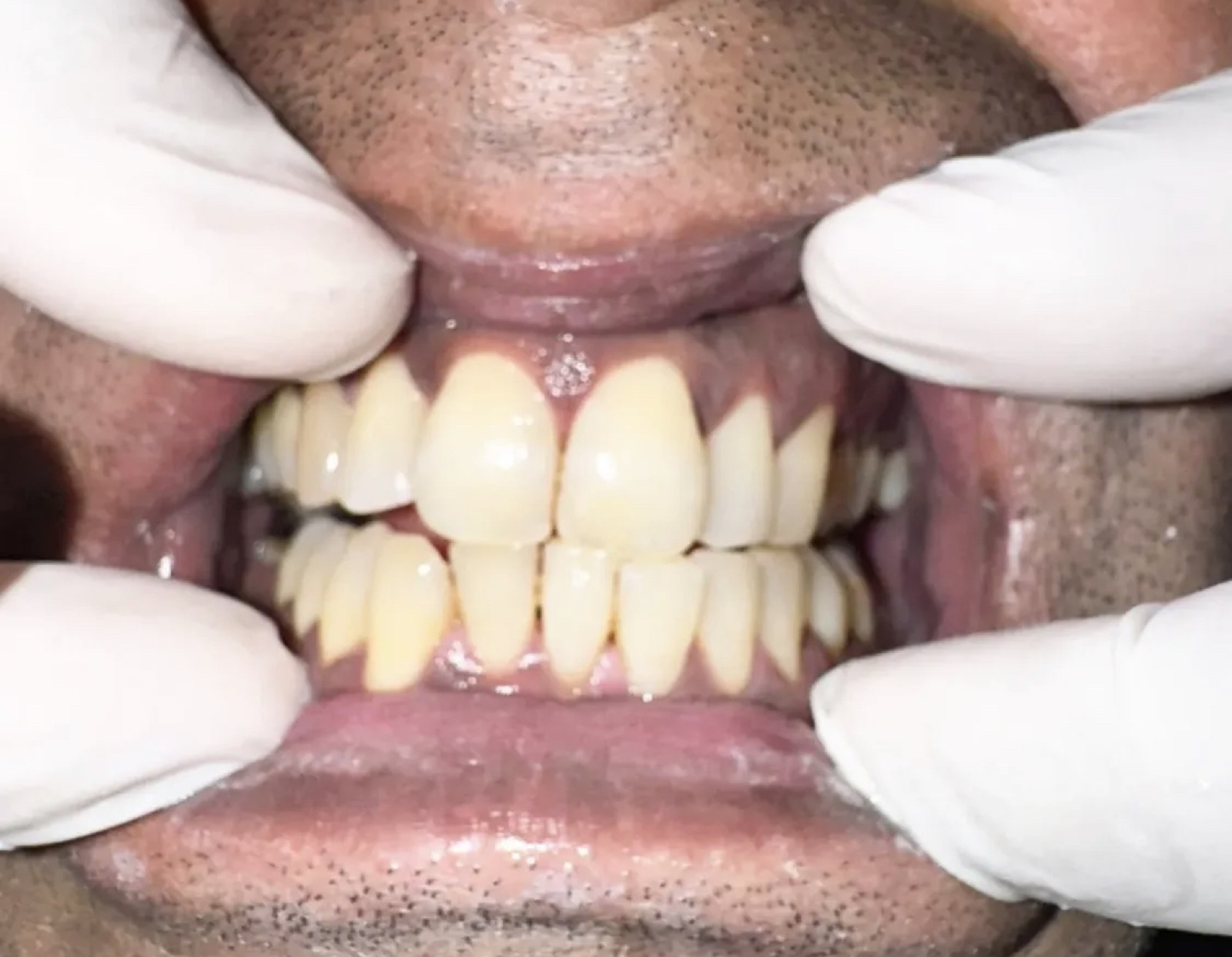 Post-SRP · pre-whiteningVisit 3 · post-whitening
Same patient. Three visits, five weeks apart.
Drag the divider across the photo to compare. The "before" was taken at the start of visit one; the "after" was taken at the end of visit three, with the same camera and the same lighting at our Lahore clinic.
BeforeAfterWhy the order of these visits mattered.
Patients often ask whether we could have done the whitening on the same day as the cleaning. The honest answer has three parts.
Bleach + inflamed gums = severe sensitivity
Whitening gel is hydrogen peroxide at thirty-five percent. On healthy gum tissue with a barrier in place, it is well-tolerated. On gum tissue that is actively inflamed and bleeding, it is a different story — the peroxide reaches sensitised nerves through the inflamed pocket and produces a kind of pain that is unnecessary, avoidable, and unhelpful. We do not bleach inflamed gums. Period.
The cleaning brightened him before the bleach did
This surprises most patients. By the end of the second deep-scaling visit, the colour of his teeth had already shifted dramatically — the bulk of the nicotine and tannin film lifted off with the calculus that was holding it. The whitening on visit three was a smaller step than the cleaning on visits one and two. The cleaning is where most of the colour change came from. The bleaching is what took it the last four shades brighter and made it bright in a uniform way.
Without the cigarettes coming down, none of it holds
Nicotine films re-lay on enamel within weeks of returning to smoking. The chemistry of the stain has not changed; the supply has. Without the cigarettes coming down, the whitening result would have unravelled within twelve months and the gum disease would have begun moving again — silently, because smoking masks the bleeding signal. The cessation conversation is half the treatment, not an afterthought.
Five questions smokers always ask.
These are the questions Mr. Usman asked, in the words he used. Tap any one to read the long answer. None of these are softened.
Will the deep scaling weaken my teeth or make them more sensitive forever?+
Honest answer for a Stage I case with a smoking history: yes, you will be meaningfully more sensitive than you would after a routine clean — and for a longer window. We need to say that out loud rather than pretend it will not happen.
Two reasons. First, the work happens below the gum line on the root surface, which is more nerve-rich than enamel. Second, smokers tend to have slightly recessed gums where more of the root is already exposed, so when we clean those exposed surfaces the sensitivity registers more strongly. Mr. Usman reported sensitivity at a 6-out-of-10 in the first week and a 2-out-of-10 by week three. Sensodyne or Colgate Sensitive twice a day for a month, plus the desensitising paste we applied at the end of the second visit, brought it down predictably. By the four-week review it was no longer a complaint.
What the scaling does not do is weaken the tooth. The structure is unchanged. The myth that scaling makes teeth loose comes from one specific situation: when calculus has been holding loose teeth in place for years and is suddenly removed, the looseness from the underlying disease becomes visible. The scaling did not cause it. The disease did. Removing the calculus is the only way out, not the cause.
Why three visits — can't we do everything in one sitting?+
We could not have done this case in one sitting and produced a result that holds. There were three reasons.
First, the deep scaling itself splits across two visits one week apart. That gives the upper arch a week to begin healing before we work on the lower, keeps each quadrant getting fresh, careful attention, and keeps both patient and operator from working through fatigue at exactly the sites where the deepest pockets are.
Second — and this is the one most patients are surprised by — whitening cannot follow scaling immediately. Bleaching the bleached gel through gum tissue that is still inflamed is needlessly painful and does not produce a stable shade result. The four-week gap between the last scaling visit and the whitening visit is not an arbitrary delay. It is the part of the treatment that lets the rest of the treatment work. If we had whitened on the same day as the second scaling, the sensitivity would have been severe, the colour would have looked patchy, and the result would have drifted within months.
Third, the four-week gap is also the gateway. We told Mr. Usman from day one that we would proceed with whitening only if his bleeding-on-probing had dropped meaningfully and his cigarette count was coming down. Both of those conditions had to hold before the third visit was booked. They held. He earned the third visit. That is how the staging works.
How painful is the scaling itself? Will I need an injection?+
Yes, and we want to be straightforward about why. For a routine scaling on healthy gums, no injection is needed — a topical numbing gel handles it. For a Stage I periodontitis case the work happens three to five millimetres below the gum line, in the pocket itself, on the root surface where the nerve fibres live. Topical gel does not reach that depth. Trying to do the work under topical alone would mean the patient is bracing in the chair and the operator is pulling back from the deeper sites — both of which produce a worse result.
What the injection feels like: about thirty seconds of pressure during the injection, ten minutes for the numbness to settle, then ninety minutes of working time during which the side of the mouth feels nothing. Mr. Usman had this done four times across the first two visits — once per quadrant — and afterwards his own description was that the part of the appointment he had been most afraid of turned out to be the smallest in retrospect.
The whitening on visit three uses no injection at all — a protective gel barrier on the gums and a desensitising paste at the end is enough. He felt mild zinging sensations during the LED cycles, which is normal and resolves within a few hours.
Will the stains and bleeding come back? How long does this last?+
Honest answer: it depends entirely on whether the cigarettes stay away. We are not pretending otherwise.
On the colour: the whitening takes the natural enamel four shades brighter (B3 to A1, in his case). Without smoking, with a five-second water rinse after every cup of tea, that shade holds at A1 or A2 for two to three years, with a quick top-up at twelve months if he wants the absolute brightness back. With smoking, the nicotine film begins re-laying within weeks. Within a year the result has unravelled enough to be visible to him, and within eighteen months we would be having the same first conversation again.
On the gum disease: periodontitis is chronic, not curable. We control it. The deep scaling result holds indefinitely — for years, decades — provided the smoking stays away and the three-month maintenance cycle holds. If the cigarettes come back, every relapse takes a little more bone with it. That is the maths of the disease, and we are upfront about it. Mr. Usman was at zero cigarettes per day at his third visit and intended to stay there. We are still seeing him every three months and the chart is stable.
How much does this cost — and what happens if I start smoking again?+
The full three-visit course came to PKR 36,000 — eighteen thousand for the four-quadrant deep scaling and root planing across the first two visits (4 × 4,500), and another eighteen thousand for the in-office laser whitening on the third visit. There were no add-ons. The four-week perio review and all photography is included.
If he starts smoking again, the gum disease begins moving again — silently, because the nicotine masks the bleeding warning. The next time we see him, the chart will look worse than it did at the four-week review, and the conversation we will have at that recall is the one we hope not to have. The treatment was successful; the result depended on the behaviour change holding. We do not penalise patients who relapse — we re-stage the work and re-quote it from the new baseline. But we are honest that the second course is harder than the first, because there is less bone to work with.
The whitening top-up alone, if he ever wants it, is PKR 8,000 in office. Annual three-monthly maintenance is PKR 4,500 per visit. None of those are surprises — they are the numbers we put in writing on day one. Nothing happens without a written quote and a sign-off in advance.
The follow-up visits.
A three-visit course is not the end of the case — it is the beginning of a maintenance cycle, with the cessation as the load-bearing piece. Every periodontitis patient at our clinic gets the same follow-up structure: a perio review, a maintenance visit, and a full review with photographs.
He came in for a brief check one week after the second scaling visit. Marginal redness was visibly reduced. The post-scaling sensitivity that had been a 6-out-of-10 in the first three days was already at a 3-out-of-10. He was using the desensitising paste twice a day. His self-reported cigarette count was down from twenty to about ten per day, with the GP-coordinated nicotine patches starting that week.
The gateway visit. Bleeding-on-probing had dropped from five sextants to one. Pocket depths in the responsive sites had closed by one to two millimetres. His cigarette count was at four per day and falling. This was the result we needed to see before we would proceed with whitening — and we saw it. The third visit was booked for the same week, and the in-office whitening took the natural shade four shades brighter.
First three-month maintenance visit. Routine supportive scaling — twenty-five minutes, no anaesthesia. The chart was stable. No new bleeding. No new staining beyond what is normal for someone still drinking five cups of tea a day. He had been at zero cigarettes for nearly three months by this point and was confident he would stay there. The next maintenance visit is on the calendar for three months out, at PKR 4,500. This is the cadence he is on now, and it is what holds the result.
Dr. Mian Momin Ahmad
“Smoking cessation is half the treatment in cases like this — and I want to be straightforward about that. The whitening is the part that photographs well, but the behavioural change is what decides whether we are sitting here in two years or whether the patient is back with the same complaint and a worse bone chart. The patient who decides to quit during the process makes our work hold for years. The patient who doesn't, we see again in twelve months for the same thing — only this time there is less bone to work with. We do not lecture. We lay out the timeline, we coordinate with the GP for nicotine replacement, and we let the patient make their decision. Mr. Usman made his on day one.”
Six daily habits that hold the result.
Aftercare for a smoker who has just quit is more rigorous than for a never-smoker. We do not pretend otherwise. These six habits are the entire deal — and the cessation is the foundation under all of them.
Soft brush + Bass technique, twice a day
Soft-bristled brush only. The Bass technique points the bristles down at the gum line at a forty-five degree angle and uses small jiggling motions, working into the small space where his pockets sit. Hard scrubbing, especially on a smoker's teeth, accelerates gum recession at exactly the sites that are already vulnerable. We sized him up for a sensitive-bristle brush before he left and demonstrated the angle in the mirror.
Interdental brushes for the larger gaps
Smokers with periodontitis often have slightly recessed gums, which leaves wider gaps between teeth than a healthy mouth — what we call enlarged embrasures. Floss does not reach into those spaces well. We sized Mr. Usman up for the right TePe interdental brushes in clinic — three different sizes for different sites — and asked him to use them after dinner every night. The space between teeth is exactly where his disease lived. Cleaning it daily is what keeps it from coming back.
The cigarettes — keep going · use the patches if needed
He was smoke-free at the third visit, and we coordinated with his GP for nicotine replacement patches in the first month — a structured step-down dose over eight weeks. We are not in the business of running cessation programmes, but we are in the business of making sure the dental work holds. Without the cigarettes coming down, the result above unravels in twelve months. With them coming down, it holds for years. We continue to ask at every recall, gently, in writing, in his file.
Reduce sweetened tea — five rinses a day
His tea is heavily sweetened, which is a separate problem from the staining. The sugar load through the day, on top of a smoker's reduced saliva flow, raises caries risk. We asked him to step down to two spoons of sugar from three, and to rinse with plain water for five seconds after every cup. Five cups a day means five rinses a day. That single habit, more than any whitening top-up, decides whether the colour holds for twelve months or thirty-six.
Three-month recall — not six
For a patient with a periodontitis history, six-monthly cleanings are too far apart. Mr. Usman is on a three-month maintenance cycle and stays on it for the foreseeable future. Each visit is a forty-five-minute supportive cleaning at PKR 4,500. We re-photograph at six and twelve months so he can see the trend. We have his next two appointments on the calendar already.
Come back immediately if bleeding returns or smoking restarts
The two warning signs we asked him to flag without waiting for the next recall: any return of bleeding on brushing, and any return to cigarettes. Either one means the disease is moving again. The instruction is to message us on WhatsApp the same day with a photograph; we will see him within forty-eight hours, no fee. Periodontitis is a disease that punishes silence. We told him the door is always open, and meant it.
We do not lecture. We lay out the timeline.
Smokers and heavy tea drinkers often delay coming in because they expect to be lectured. We do not lecture. We do not raise our eyebrows when you tell us how many cigarettes a day. We sit you down, we show you the X-ray, we map the smoking against the bone loss in plain numbers, and we let you decide what you want to do about it. That is the whole approach. It is the approach Mr. Usman experienced. It is the approach we use with every smoker who walks in.
What waiting another year actually does, in plain terms, if the cigarettes continue:
None of that is a scare tactic. It is the timeline we see in our chair, every week. The fix at forty-five, with the cigarettes coming down, is three visits over five weeks. The fix at fifty, with the cigarettes still going, is rarely as simple. We would rather see you for the easy version.
More on stains, gum disease, and the work behind it.
Three more patients like Mr. Usman.
Every case in this archive is a real Odonto patient with their consent. Names are accurate where the patient was happy to share them, age ranges are real, and every photograph was taken in our Engineers Town clinic.
Want a result like Mr. Usman's?
The first 15 minutes are free. We will examine your teeth and gums, take any photographs needed, and put a written quote in your hand. There is no pressure to book the cleaning the same day, and there are no hidden charges if you do.