How a Lahore senior manager stopped hiding his smile in client meetings
Mr. Imtiaz had been raising his hand to his mouth in meetings without thinking about it. He had cropped himself out of a team photograph the previous quarter. He had a major conference presentation in two weeks. This is the full story of the fifty-five minutes that changed his on-camera life — what we found, what we did, what surprised him, and what we asked him to do at home to keep the result.
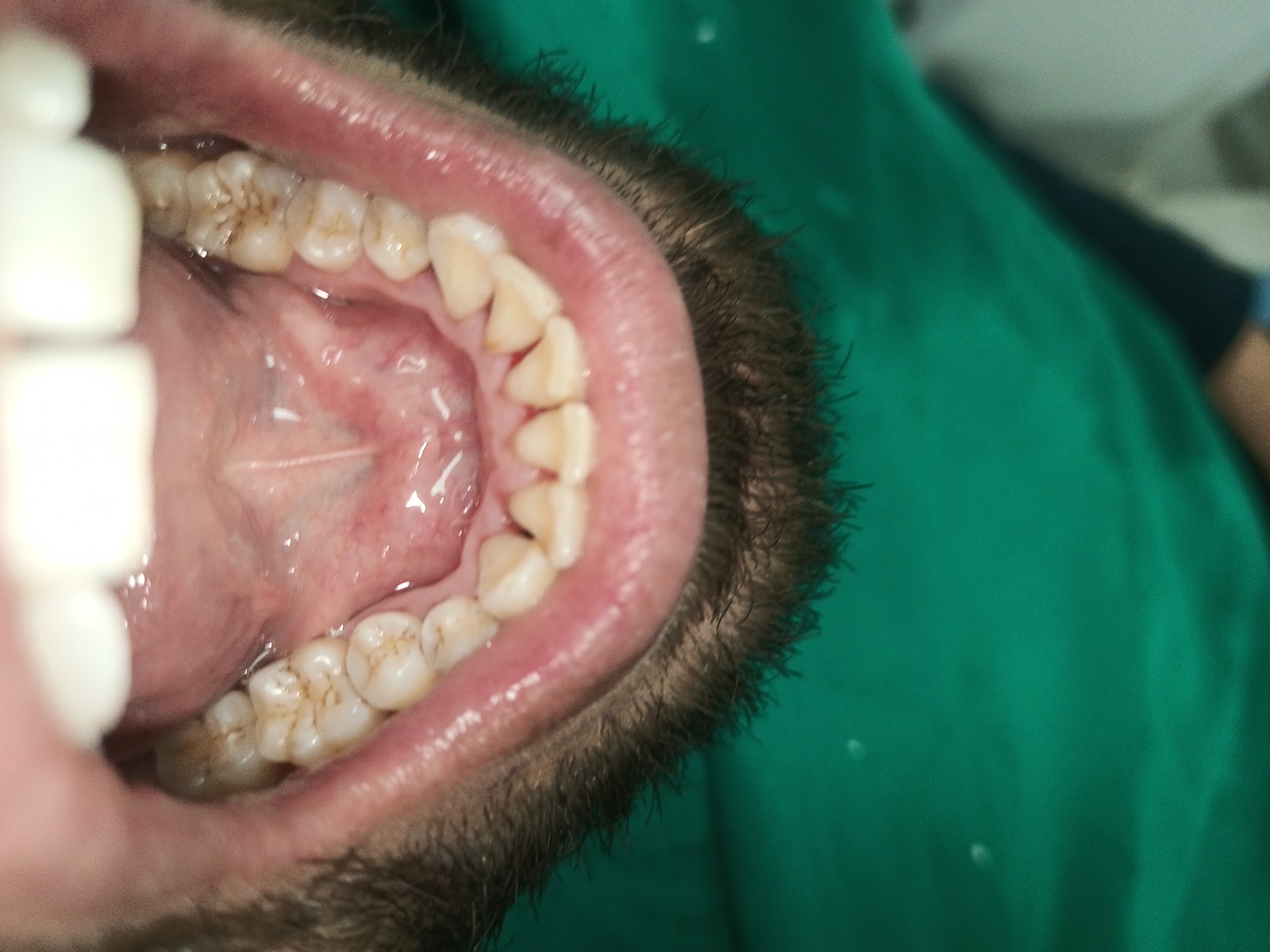
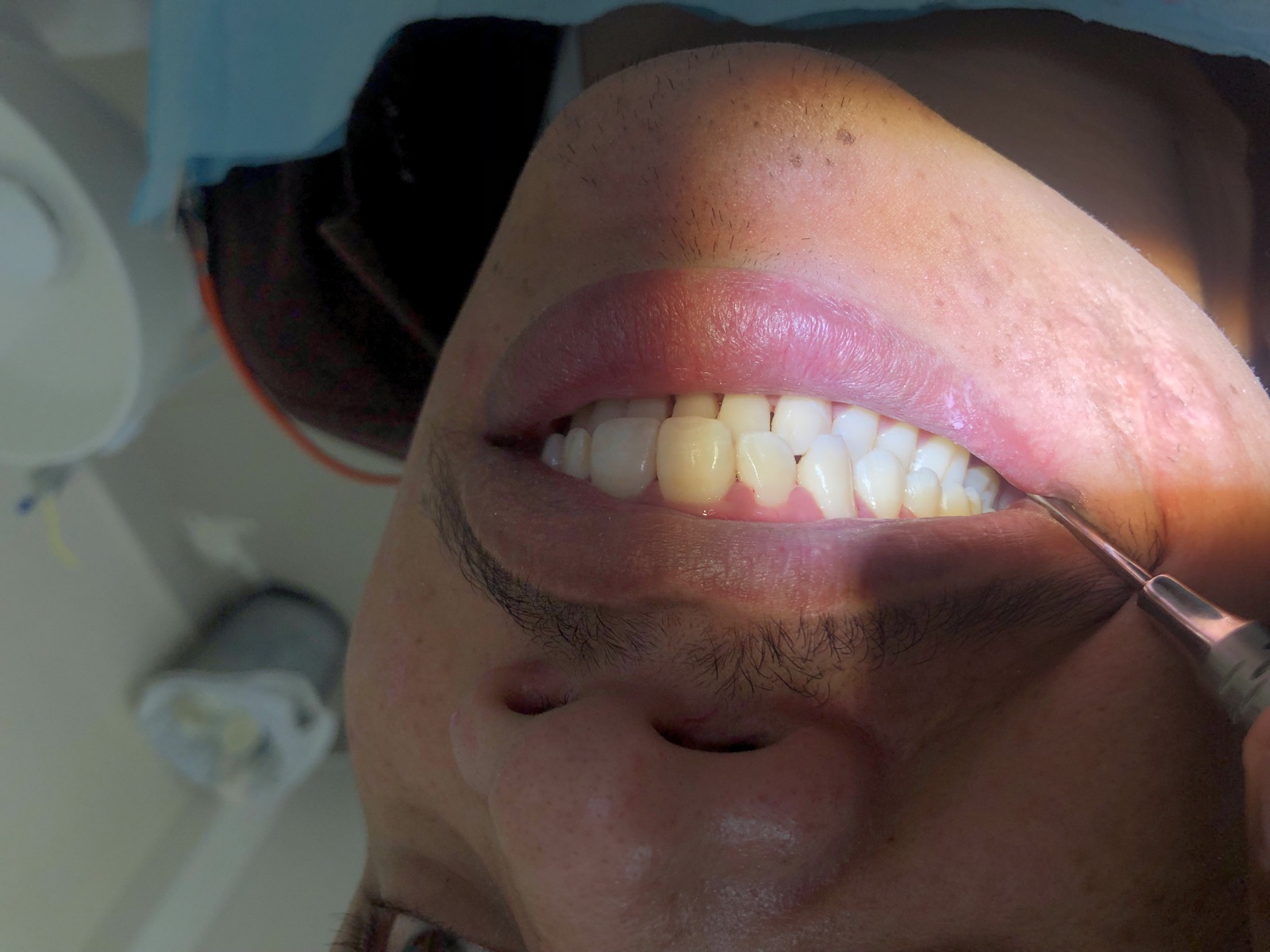
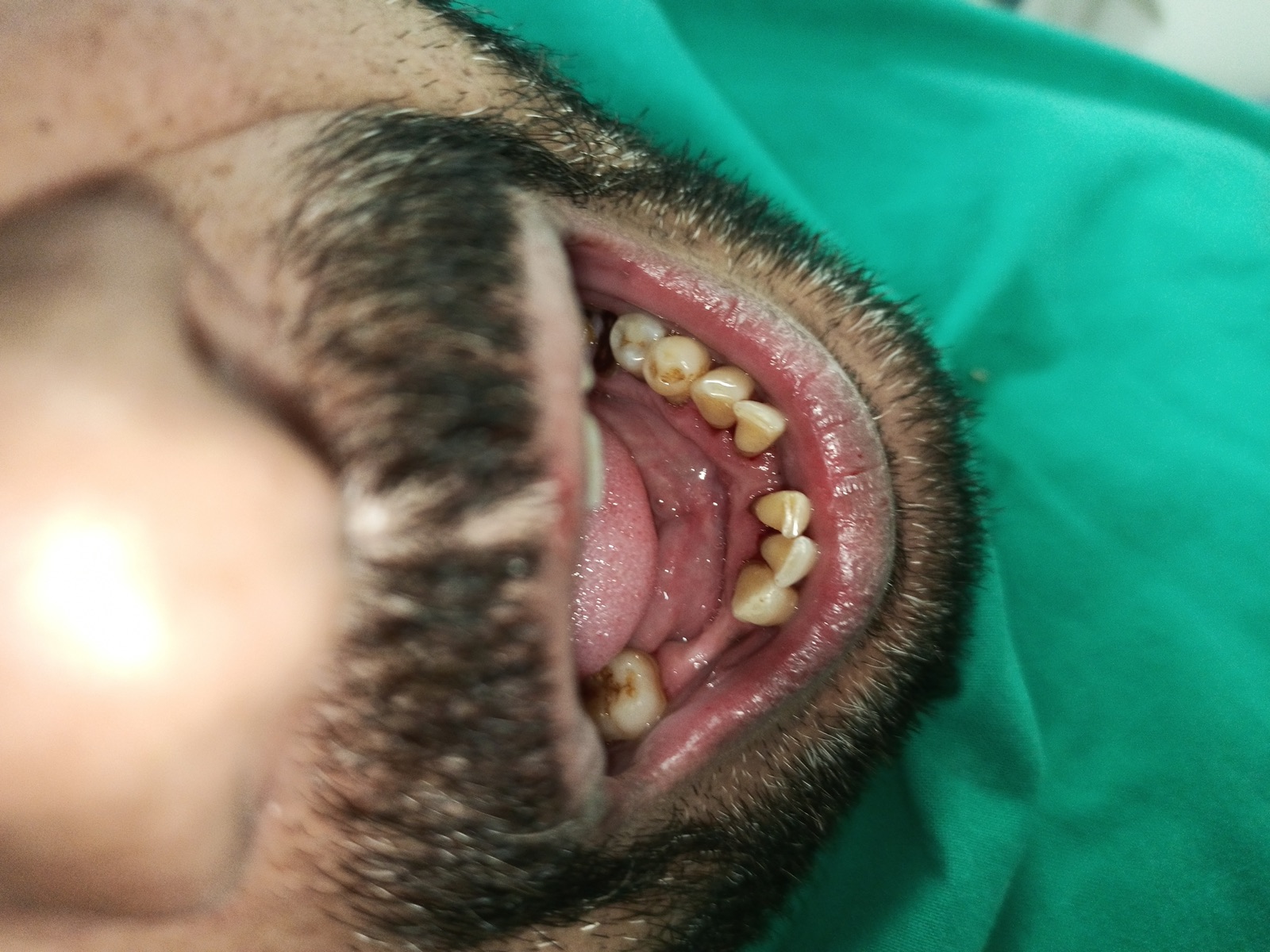
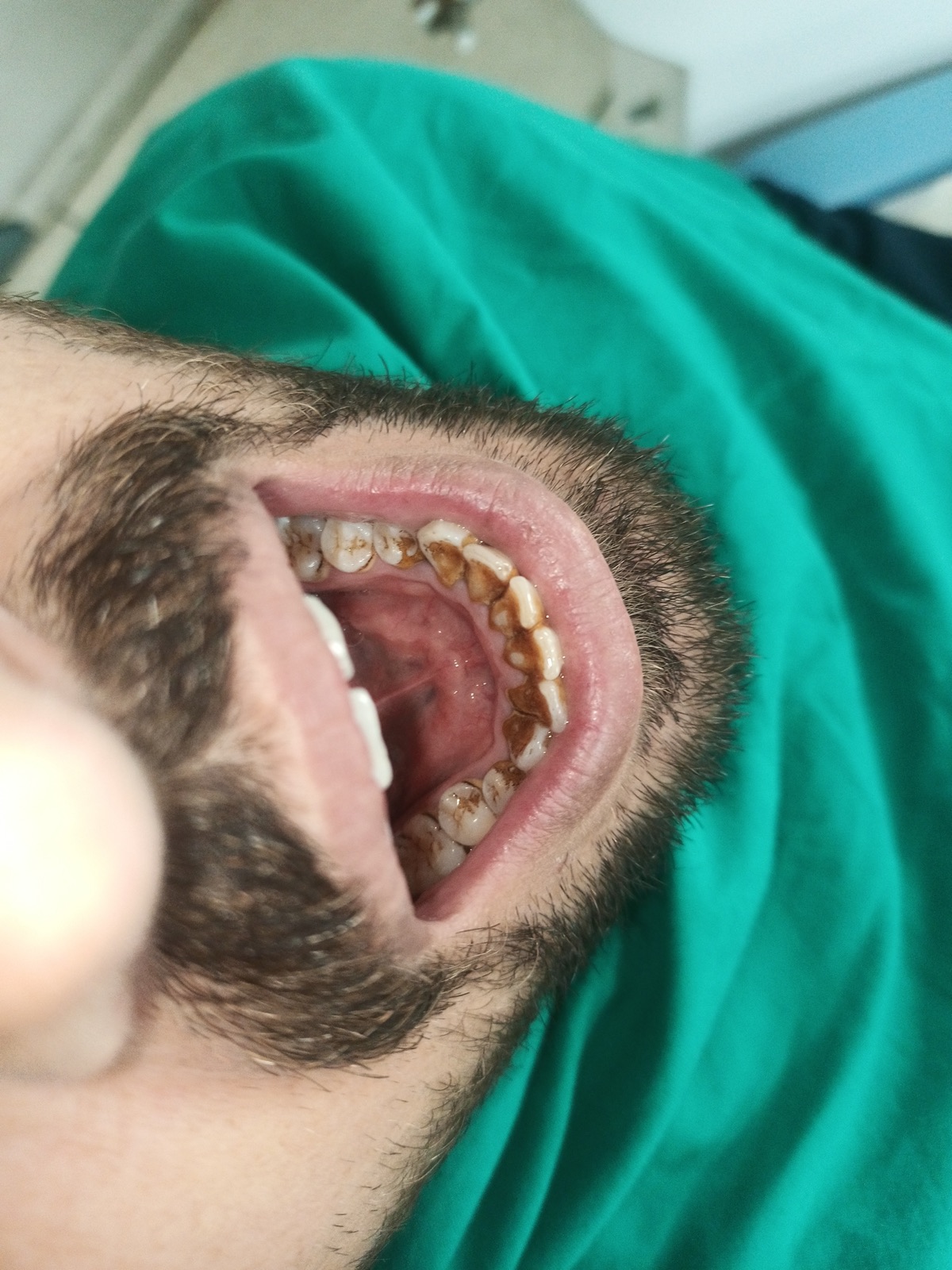 Before
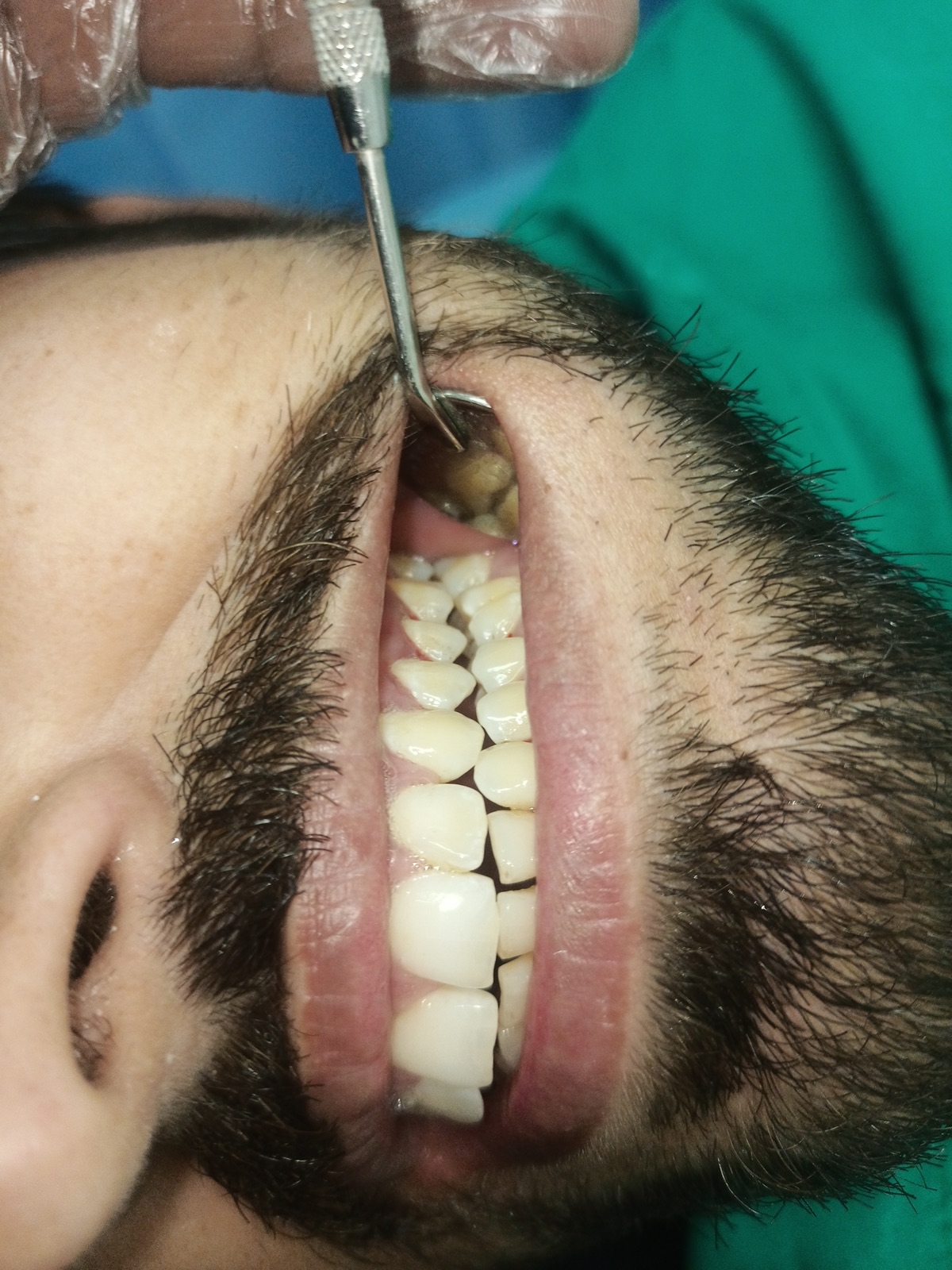 After
AfterHe had stopped smiling in photos.
Most patients we see at this stage of calculus are not people with poor hygiene. They are people whose teeth, for one geometric reason or another, are slightly harder to keep clean than average. Mr. Imtiaz is one of them.
Mr. Imtiaz is a senior manager at a multinational firm in Lahore. He is thirty years old, runs client-facing presentations on a weekly basis, and has been in meetings — face to face, on Zoom, in conference rooms — almost every working day of his career. Until two years ago, he had not thought about his teeth in any meaningful way since he was eighteen.
He brushes twice a day. He flossed sometimes, when he remembered, but had never been taught the technique properly. The harder part of his story is that his lower-front teeth are crowded — mildly but distinctly — in a way that no toothbrush, no matter how dutifully used, could fully reach. The bristles either rode over the angled surfaces or pushed his gum aside without ever fully cleaning the enamel just below. Plaque sat. Saliva mineralised it. Calculus accumulated regardless of how conscientiously he brushed.
None of this is unusual for a patient with crowded teeth. The pattern we see again and again is the same: regular brushing at home, no professional cleaning for years, mild crowding in the lower arch, and a slow accumulation of calculus in a zone the patient cannot reach with their toolkit at home. By the time someone like Mr. Imtiaz looks in the mirror and decides something needs to be done, the deposits have been there for so long that the patient is convinced they must reflect some fundamental personal failure. They almost never do. They reflect geometry that needs a different toolkit.
The thing that finally brought him in was a quiet moment after a quarterly close. His team had taken a group photograph in front of the conference-room wall, the kind of photo that goes onto the company intranet and the LinkedIn account of every person in it. He had cropped himself out before he sent it. His wife, who had not been asked, mentioned that he had been cropping himself out of family photos as well. The next morning he had a major industry conference on his calendar — fourteen days away — at which he was scheduled to deliver the keynote. He searched on his phone, called us, and arrived for a same-week appointment.
The first appointment ran the full hour. We took six standardised photographs. We measured the gum at six points around every tooth. We applied a plaque-disclosing solution and showed him, on the chair-side monitor, exactly where his current technique was missing — a deep purple stripe along the lingual surface of his lower front teeth, plus most of the interproximal contacts in the lower arch. The visual was, in his words, "humbling but useful."
No bone loss. No attachment loss. No deeper periodontal disease. The tooth structure underneath the calculus was perfectly intact. Despite the dramatic look from outside, what he had was heavy supragingival calculus, mild gingivitis driven by the calculus, and a brushing technique that had not kept up with his crowded geometry. All three are reversible with a single thorough deep scale plus a structured technique re-education before he left the room. The presenting cosmetic problem was bigger than the underlying clinical one. We told him so.
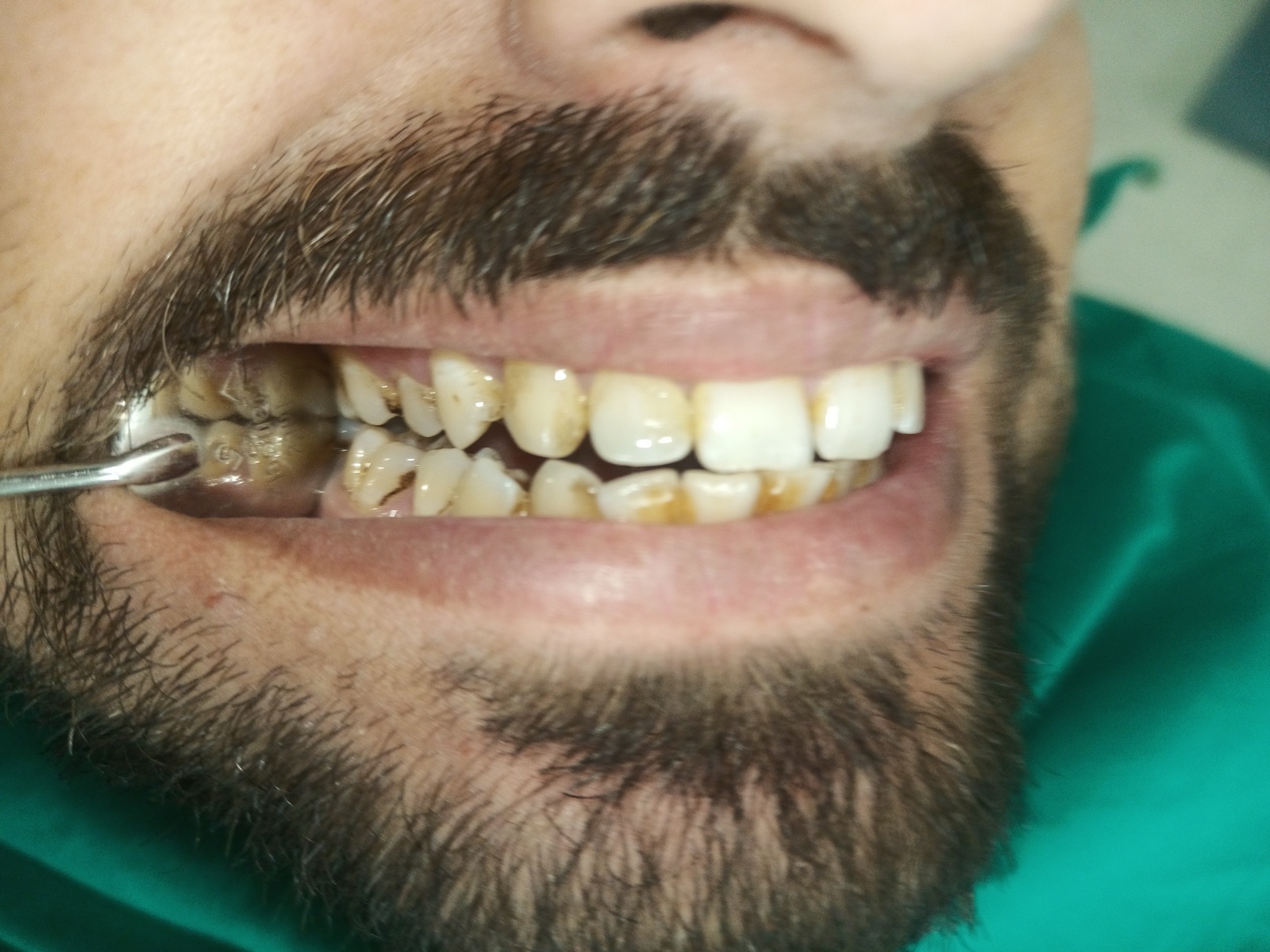
Four things — explained in plain English.
Most patients are nervous that something serious will be discovered. We always start with what we've ruled out, then walk through what we did find — without scary words and with a clear plan for each.
Heavy calculus on the lower front teeth
A thick, yellow-grey collar of tartar had built up along the back surfaces of his lower front teeth and was beginning to creep onto the visible side. This is the single most common pattern we see in adults with crowded lower incisors — and it is not a hygiene failure. Saliva enters the mouth from glands beneath the tongue, flows directly across the lingual surface of the lower anteriors, and deposits the minerals it carries onto whatever plaque is sitting there. If the bristles cannot reach a contact, the plaque sits, and within forty-eight hours the saliva mineralises it into rock-hard calculus. Crowding doubles down on this because some interdental zones become geometrically un-brushable. The fix is professional access — which an ultrasonic scaler and Gracey curettes provide.
Plaque-induced staining, not chai-driven
The brown-grey discolouration sitting on top of his calculus was not the chromogenic tea pattern you see in heavy chai drinkers. It was secondary staining — pigment from food, drink, and the simple oxidation of the tartar surface itself. This kind of stain lifts off the moment the underlying calculus is removed, because the stain is essentially a thin film bonded to the tartar, not to the enamel. We confirmed this by gently testing a small area at the start of the appointment. Within seconds of the ultrasonic touching the deposit, the brown film flaked off the same surface as the calculus underneath.
Mild gum inflammation, especially lower
When we tested his gums at six points around every tooth, five of the six areas of his mouth bled within seconds. This sounds alarming — at this stage it almost never is. Bleeding gums in a thirty-year-old with no bone loss and no deep pockets almost always mean the gum is irritated by plaque sitting along the tooth, not that something is decaying or infected deeper down. It is reversible. The fix is to remove the plaque the gum is reacting to, and the gum then calms down within seven to ten days. The lower-anterior zone — where the crowding made hygiene hardest — was where most of the bleeding lived.
Crowding is real — but not your priority right now
His lower incisors are mildly crowded — Little's Index roughly five millimetres, which is a moderate but not severe degree of irregularity. Brackets or aligners would help him at some point, and we noted it in the chart. But putting orthodontic appliances into a periodontally inflamed mouth multiplies problems rather than solving them. The right sequence, every time, is hygiene first, four months of stable home care second, and only then a conversation about alignment from a clean baseline. We agreed in principle that an orthodontic consult could happen at his four-month recall if he wanted to take it forward. Bone level on radiograph was intact. Cleared for non-surgical scaling.
Four steps. All in one sitting.
Every step was explained before it happened. He could see what we were doing in a small mirror at any point. There was no rush.
Exam, photos, and a brushing demo on a model
We took six standardised photographs at the same angles we use for every patient. We measured the gum at six points around every tooth — what we call charting. We applied a plaque-disclosing solution that turns missed plaque purple, and the lower-anterior lingual zone lit up in the deep purple of long-term inadequate cleaning. Then, before the ultrasonic touched a tooth, we walked him through the modified Bass technique on a teaching model. The fact that he could see, in colour, exactly what his old technique was missing was half the consultation.
~ 10 minA topical numbing gel for the cervical band
No injection. The line where the gum meets the tooth on his lower-front teeth was where the densest tartar sat, and that area is sensitive to the ultrasonic when deposits are this thick. A small dab of benzocaine 20% gel on a cotton bud, brushed along the gum margin from canine to canine, took the edge off completely. He felt only a buzzing sensation for the duration of the appointment.
~ 5 minUltrasonic plus Gracey hand instruments
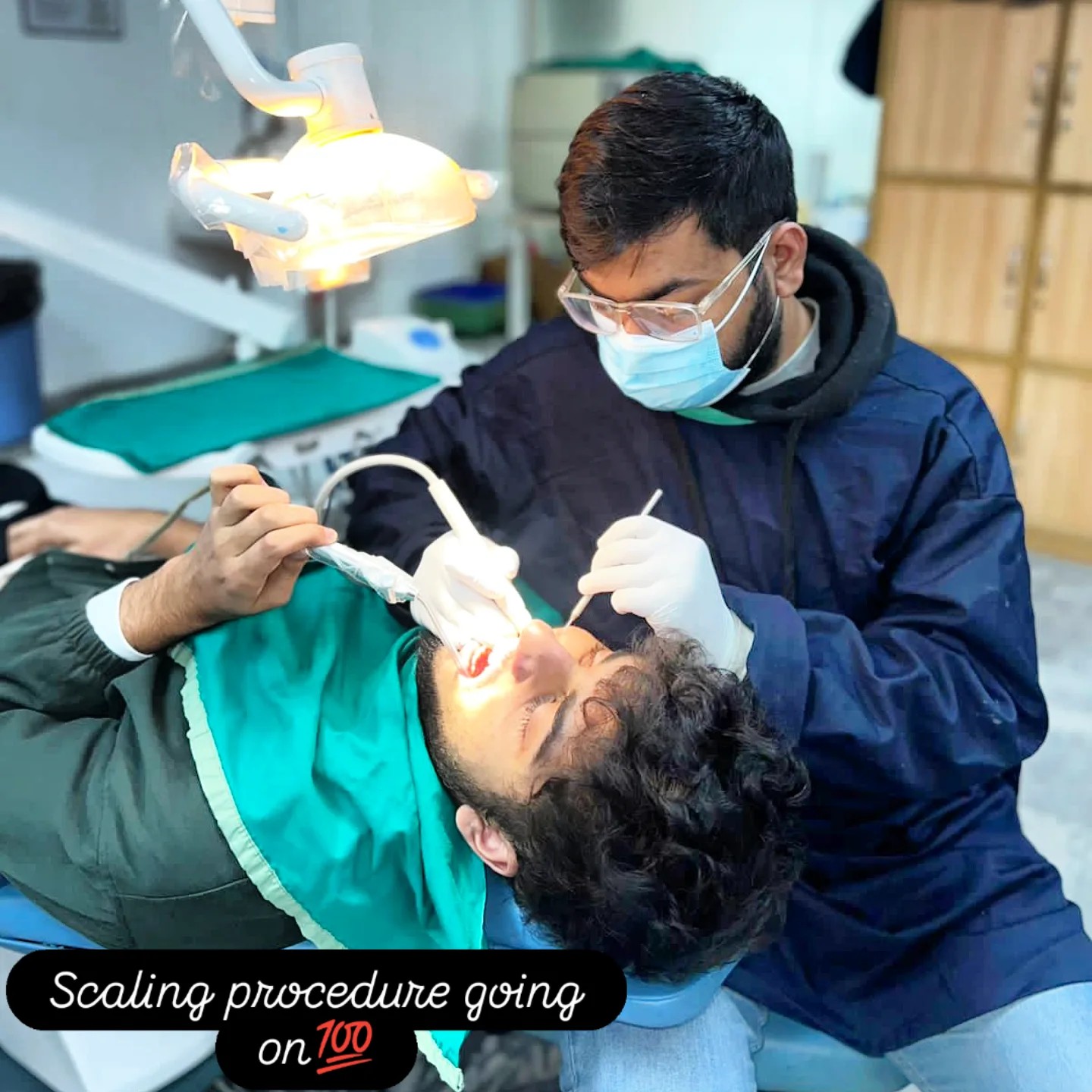
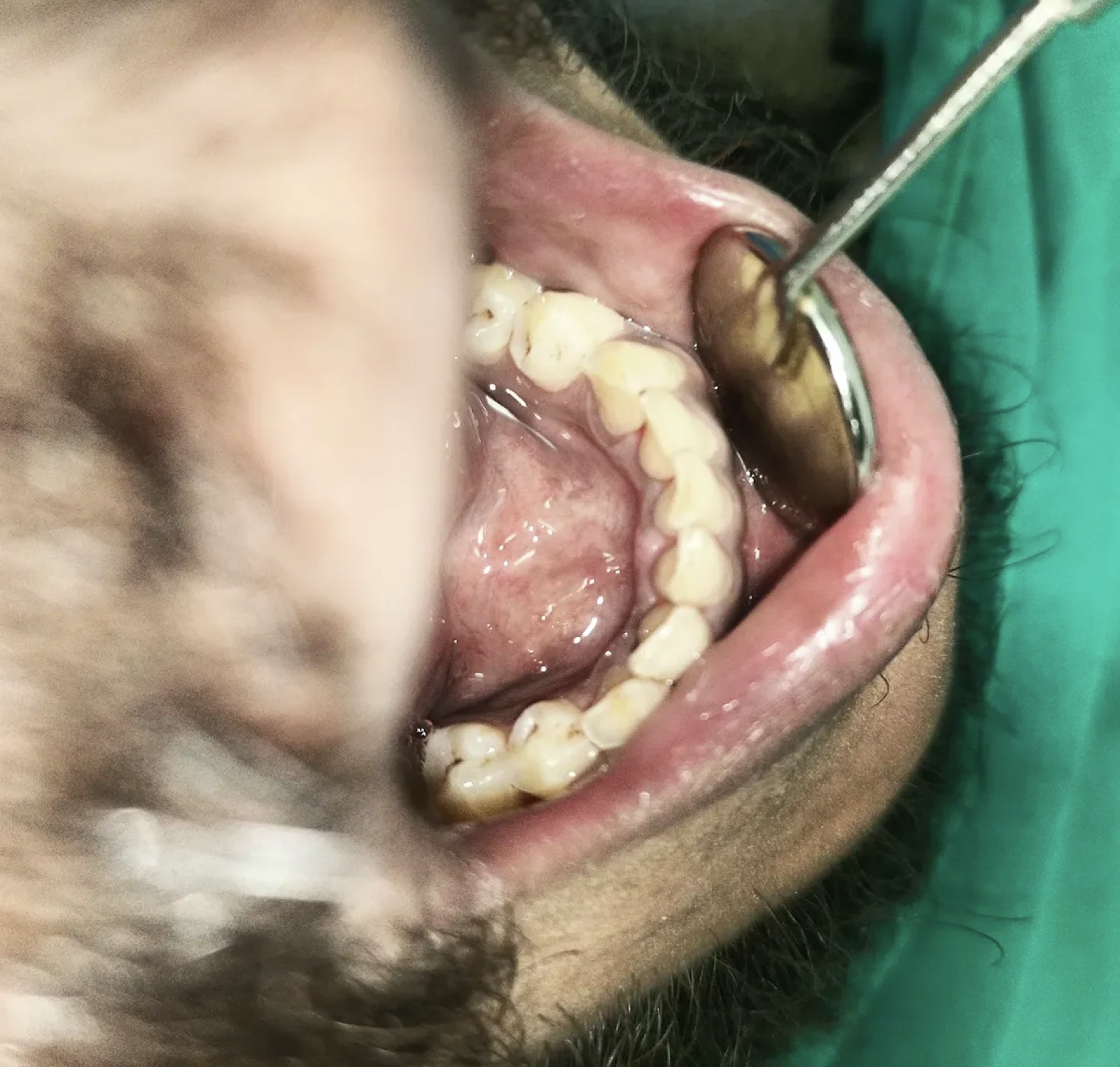
A piezoelectric scaler with continuous water cooling, working in the standard upper-right to lower-right sequence. Most of the visible calculus came off cleanly — the upper teeth, the lower posteriors. The lower-front lingual zone was different. The crowding shielded several proximal contacts from direct ultrasonic access, so we switched mid-quadrant to fine Gracey hand instruments, which let us reach into the angles between his crowded incisors without forcing the tip. This is the part of his case that takes longer than a routine scale, and it is the part that decides whether the result holds.
~ 30 minPolish, interdental brush sizing, and recall
A medium prophy paste applied with a slow rubber cup, plus a sodium-bicarbonate air-flow polish to lift the brown film overlying the calculus. Then the part that mattered most for his maintenance: site-by-site sizing of small interdental brushes against his lower-anterior contacts. We tested a TePe size 1, then a size 2, and confirmed the size 2 reached every surface in the crowded zone in two seconds. Chlorhexidine 0.12% mouthwash prescribed for seven days. A printed aftercare sheet with his specific IDB sizing went home with him.
~ 10 min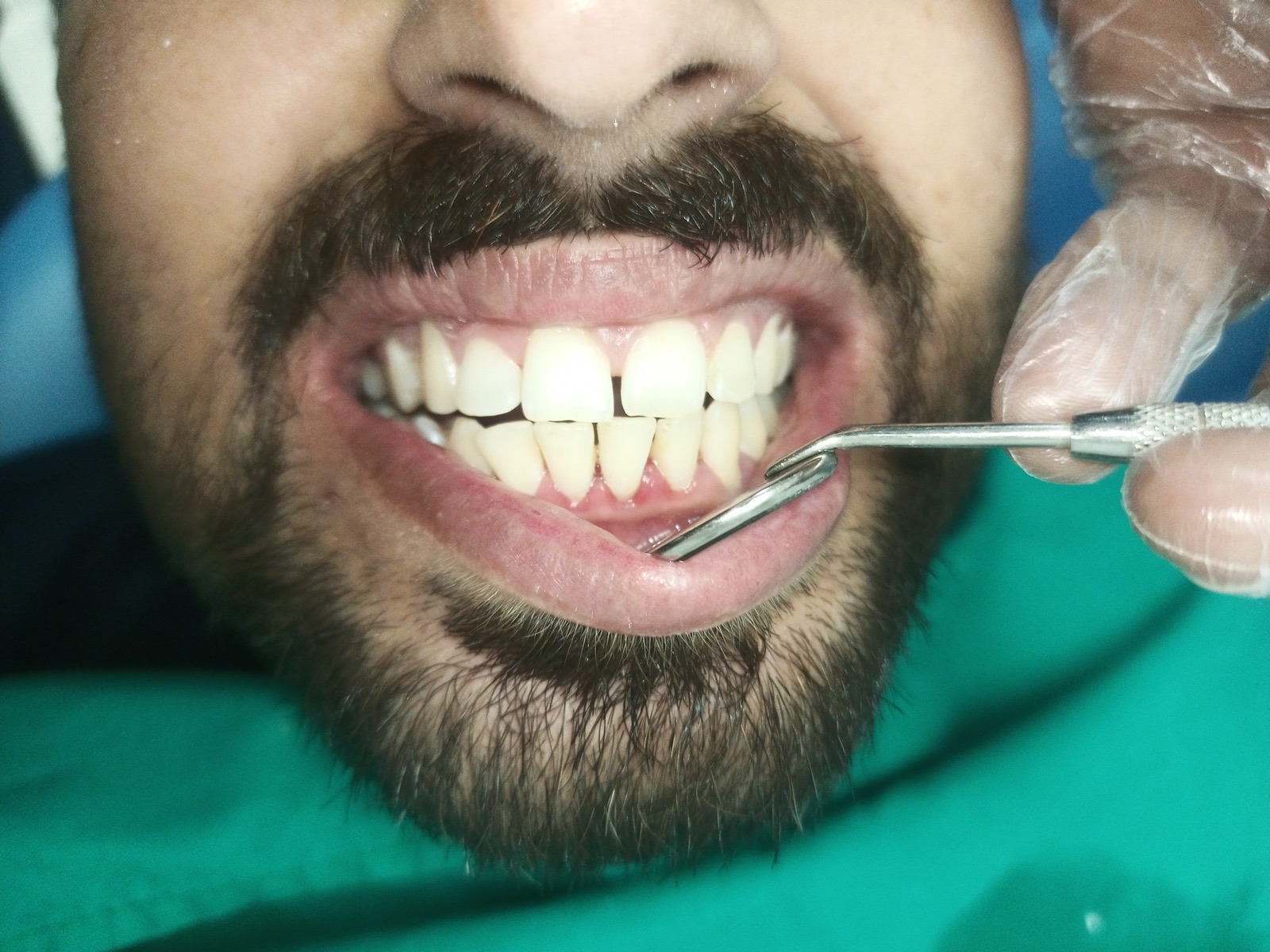 During — ultrasonic phase
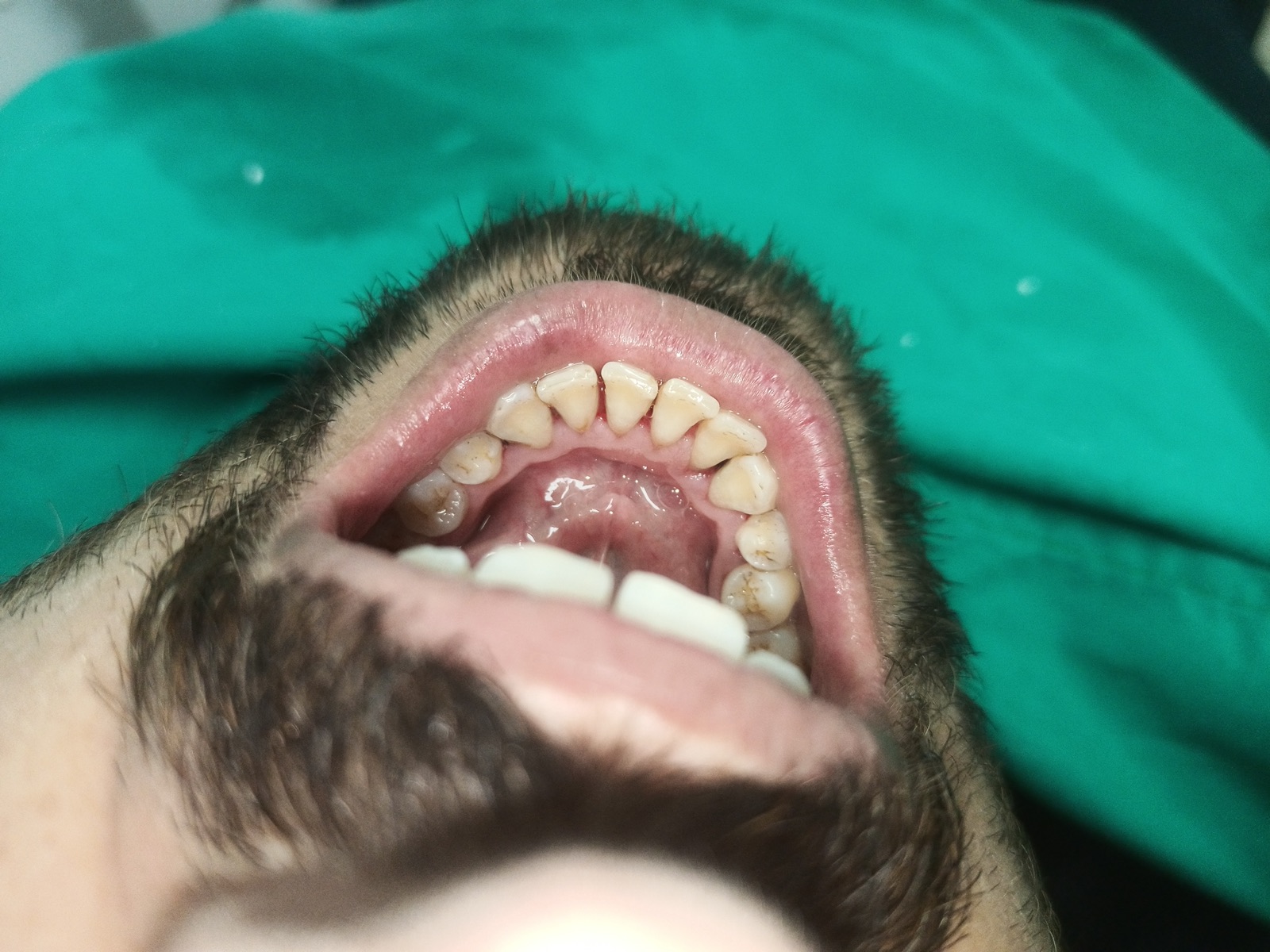 After — final polish
Same patient. Same chair. Same day.
Drag the divider across the photo to compare. Both photos were taken with the same camera and lighting inside our Lahore clinic — "before" right as he sat down, "after" before he stood up.
BeforeAfterWhy a toothbrush cannot do this.
Patients often ask, reasonably, why brushing for years did not prevent this from building up. The honest answer has three parts. None of them are your fault — especially in a mouth with crowding.
Plaque becomes tartar in 24 to 48 hours
Plaque is the soft, sticky film of bacteria that forms on every tooth, every day. Brushing removes most of it. But anywhere your brush misses — the lingual side of crowded lower incisors is the most common spot in adults — the saliva mineralises that plaque into rock-hard tartar within one or two days. Tartar is rock-hard. Once it forms, no toothbrush in the world will remove it. That is what the ultrasonic scaler is for.
Crowded teeth need a different toolkit
A brush bristle is roughly half a millimetre wide. The angle between two crowded incisors can be geometrically narrower than that. A bristle physically cannot enter the contact, and pushing harder only damages the gum. The right tool for these zones is an interdental brush sized to the specific contact — TePe size 1, 2 or 3 — chosen chair-side. Once the right size is in your bathroom drawer, the maintenance becomes straightforward.
Gum inflammation reverses in 7 to 10 days
The bleeding gums that frightened Mr. Imtiaz at the chart are not a long-term sentence. They are the gum's reaction to plaque sitting on the tooth. Remove the plaque, and the gum begins to repair itself within forty-eight hours. By day seven, most of the bleeding has stopped. By day ten, the margin looks visibly tighter and pinker. The deep scale handled the historic deposits; the new technique handles the daily prevention. The two together explain his one-week follow-up reading.
Five questions our patients always ask.
These are the worries we hear most often, in the words our patients use. Tap any one to read the long answer.
Will scaling weaken my teeth or make them more sensitive forever?+
This was the worry Mr. Imtiaz had walked in with, and the honest answer is: no — but you may feel mildly sensitive for the first three to five days, and we want to explain why so it does not surprise you.
When tartar this thick is removed, the enamel underneath is exposed to cold air, cold drinks, and even the airflow from a normal breath, sometimes for the first time in years. That sensation registers as sensitivity for 24 to 72 hours, occasionally up to a week for a patient with as heavy a deposit as Mr. Imtiaz had. Using a sensitive toothpaste like Sensodyne for one to two weeks handles it almost completely. After that, the sensitivity is gone — and the tooth is structurally stronger because the underlying surface is now clean and able to absorb fluoride from your toothpaste again.
The myth that scaling weakens teeth comes from a specific situation that does not apply to him: when calculus has been holding loose teeth in place for years and is suddenly removed, the looseness becomes obvious. The scaling did not cause it. The gum disease underneath did. Mr. Imtiaz had no bone loss and no attachment loss on the chart. His teeth were never loose. The calculus was sitting on stable, healthy bone.
Why did I see gaps between my teeth right after the cleaning?+
Those gaps were always there. Calculus and a thin layer of plaque were filling the contact points between his crowded teeth, almost like grout between irregular tiles.
When we remove the calculus, the original spacing — the spacing your teeth actually have, including the geometry of any crowding — becomes visible again. Mr. Imtiaz noticed two small visible spaces in the lower anteriors on day one. He asked about them; we showed him in the mirror that they are part of how his teeth naturally meet, and that they had been masked by tartar for years. By day three he had stopped thinking about it. If he proceeds with orthodontic treatment later, those geometric quirks will resolve as the alignment is corrected.
Hiding gaps with calculus is the wrong way to keep them hidden. Calculus above the gum line is followed by calculus below the gum line, which is followed by gum disease, which is followed by actual bone loss. That progression takes years — but it is the path. Cleaning is the way out of it.
How painful is the scaling itself? Will I need an injection?+
For a patient with deposits as heavy as Mr. Imtiaz had, we typically use topical anaesthesia at the cervical band of the lower anteriors — the densest deposit zone — and nothing else. No injection. The ultrasonic tip vibrates at a high frequency and runs cool water over the tooth at the same time. The sensation, even on heavy tartar, is best described as a buzzing or a tickle, plus a little pressure where the deposit is being lifted off.
Where patients sometimes feel a sharper sensation is at the gum line itself, because that area has the most concentrated nerve endings and is also where the heaviest tartar usually sits. For those specific areas we apply a topical numbing gel — a cotton bud, no needle — which dulls the sensation completely. Mr. Imtiaz needed only the topical gel.
If a patient has very deep deposits below the gum line, we sometimes use a single small local anaesthetic injection. This applies to roughly one in twenty cases. Mr. Imtiaz did not need it. He told us afterwards that the appointment was less uncomfortable than the dental check-ups he remembered from school.
Will the calculus come back? How long does the result last?+
Yes — slowly — if you do nothing. No — for years — if you change one or two small habits.
For a patient with crowded lower incisors, the lingual surface of those teeth will always be a slightly higher-risk zone for calculus reformation than for someone with perfectly aligned teeth. That is geometry, not effort. The single most useful daily habit for Mr. Imtiaz is the interdental brush in his lower anteriors — thirty seconds in front of the bathroom mirror, every night, takes the lingual zone from impossible-to-clean to clean. Combined with the modified Bass technique on his soft brush, the home-care toolkit he left the clinic with covers every surface that historically had been a problem.
We re-photograph every patient at four months and again at twelve. You can see your own trend on a printed sheet, and we adjust the recall interval if your habits change. His next photograph is scheduled for May 2025, and his one-year baseline for January 2026.
Eventually, an orthodontic conversation may simplify the maintenance further by removing the geometric difficulty altogether. We left that decision with him, on his timeline, from a clean baseline.
How much does this cost? Are there hidden charges?+
Mr. Imtiaz paid PKR 5,500 — our deep scaling tariff, which includes the topical anaesthesia, the air-flow polish, the interdental brush sizing, the chlorhexidine prescription, and the printed take-home aftercare pack. A standard scaling without the deep-instrumentation component is PKR 4,500.
There is no extra charge for the consultation, no charge for the photographs, no charge for the X-rays needed to rule out bone loss, and no charge for the topical anaesthetic gel. If we discover during the cleaning that you actually need deeper work — root planing per quadrant, for example — we will stop, show you the X-ray, explain why, and write a separate quote before we proceed. Nothing happens without your sign-off.
His four-month recall visits cost PKR 4,500, since the deep deposits are no longer present and each visit is a routine maintenance clean.
The follow-up visits.
One scaling is not the end of a case — it is the beginning of a maintenance cycle. For patients with crowded teeth, we run a tighter follow-up structure: a quick review at one week, a check at one month, and a full repeat appointment at four months. Here's how Mr. Imtiaz's went.
He came in for a ten-minute review at one week. Bleeding-on-probing had reduced from five sextants to two — both residual sites in the lower-anterior crowding zone, exactly as we had expected. Photographs retaken. He told us he had given his conference keynote three days earlier, had not thought about his teeth once during the talk, and had caught himself smiling in the lobby photos afterwards without raising his hand.
Mr. Imtiaz returned for a quick check at four weeks. We applied the disclosing solution again — the lower-anterior lingual zone was, for the first time in years, uniformly clean. The interdental brush he had been awkward about at handover had become routine. Confidence in client meetings reported as "back to normal." The orthodontic conversation was deferred to the four-month review, by his choice, as planned.
He returned in May for the four-month recall. Routine scaling and polish performed in twenty-five minutes. BoP down to one sextant. Plaque index halved from baseline. Same six photographs taken so we could compare against January. He paid PKR 4,500 — the routine maintenance fee. He also elected to take the orthodontic referral letter we had drafted at the original consultation, and the crowding conversation moved forward from a clean, stable baseline.
Dr. Mian Momin Ahmad
“Crowded teeth are not a hygiene failure. They are a hygiene challenge, and the patient who walks in with a heavy lower-anterior calculus collar usually carries a private theory that they have somehow earned it. The truth is geometric: a brush bristle physically cannot enter certain contacts, and the right toolkit is an interdental brush of a specific size, plus a slightly different brushing motion. Once that toolkit is set up — chair-side, in front of a mirror, with the patient mirroring what I'm doing on a model — the result holds. The most important twelve minutes of Mr. Imtiaz's appointment were not the deep scaling. They were the technique demonstration that came afterwards.”
Six small habits that hold the result.
A clean is not the end of the story. The teeth stay this way only if a few small things are done at home. These six are the only ones we asked Mr. Imtiaz to commit to — the toolkit is specific to a mouth with mild crowding.
Soft brush plus modified Bass technique
Mr. Imtiaz had been using a hard-bristled brush with a horizontal scrub motion, about forty-five seconds twice a day. We swapped him to a soft-bristled brush and demonstrated the modified Bass technique chair-side — bristles angled at forty-five degrees to the gum line, small vibratory motions, then a roll-off. Two minutes total. The technique change is, in our experience, the single most useful long-term intervention for a patient with crowded teeth.
TePe interdental brush size 2 — daily, lower front
For the crowded zone in his lower incisors, a TePe size 2 interdental brush reaches every surface in under three seconds per contact. Once a day, in front of the bathroom mirror after dinner, takes about thirty seconds total across the relevant gaps. This is the brush that most directly prevents the calculus collar from reforming where it had originally accumulated. The size is specific to him — we tested it chair-side.
Floss for the tighter contacts
Where his contacts are too tight for an interdental brush — the upper anteriors and the back molars — dental floss is the right tool. Once a day, after dinner, takes about ninety seconds. The interdental brush handles the lower-front crowding; the floss handles everywhere else. Together they cover the surfaces a toothbrush mathematically cannot reach. For a patient with crowded teeth, both tools are necessary, not optional.
Five-second water rinse after every chai
A small habit that prevents the secondary brown film from coming back. Five seconds, plain water, swished between the teeth, after every cup of tea or coffee. Mr. Imtiaz drinks three to four cups of chai during a working day. Three to four rinses, taking twenty seconds in total. The pigment that would otherwise sit on the enamel for forty minutes between cups gets washed off before it has a chance to bond to anything.
Skip the whitening toothpaste
He had asked us about a whitening toothpaste before he sat in the chair. We asked him to wait. Most "whitening" toothpastes are mildly abrasive — they work by sanding off surface stain. Right after a deep scale, the enamel is at its smoothest and most vulnerable to abrasion. Using one for the first month would actually undo some of the work. We asked him to use a regular fluoride toothpaste — Sensodyne or Colgate Total — for at least eight weeks before reconsidering.
Four-month recall — not six
For most patients, a six-month recall is the right interval. For patients with crowded teeth, where some interdental zones remain mathematically harder to clean even with perfect technique, we tighten that to four months. The visit is shorter and the same fee, but the closer interval prevents the calculus collar from rebuilding to anything like its original density. His next visit is on the calendar for May. If he proceeds with orthodontics, the recall stays tight for the duration of treatment.
Delaying because you assume crowded teeth need braces first is exactly backwards.
We do not lecture about postponement. The reasons we hear are real — the assumption that orthodontics should come first, the fear that a deep clean will hurt, a busy professional life that swallows two-week planning windows whole. None of those are stupid. They are why we are still able to take walk-ins on most weekdays.
The right sequence, every time, is clean first, then decide on alignment from a clean baseline. What waiting another year actually does, in plain terms:
None of that is a scare tactic. It is the timeline we see, in our chair, in this clinic, every week. The fix at this stage is still a single fifty-five-minute visit. The fix in five years is rarely as simple.
More on scaling, and the conditions behind it.
Three more patients like Mr. Imtiaz.
Every case in this archive is a real Odonto patient with their consent. Names are accurate where the patient was happy to share them, age ranges are real, and every photograph was taken in our Engineers Town clinic.
Want a result like Mr. Imtiaz's?
The first 15 minutes are free. We will examine your teeth, take any photos needed, and put a written quote in your hand. There is no pressure to book the cleaning the same day, and there are no hidden charges if you do.