How a busy Lahore lawyer cleared a decade of tea stains in one 45-minute visit
Mr. Nawaz had stopped smiling in court because of the dark stains on his teeth. His gums bled when he brushed. Bad breath had started getting noticed by colleagues. He had been telling himself for four years that he'd "get a cleaning next month." This is the full story of the visit that finally happened — what we found, what we did, what surprised him, and what we asked him to do at home to keep the result.
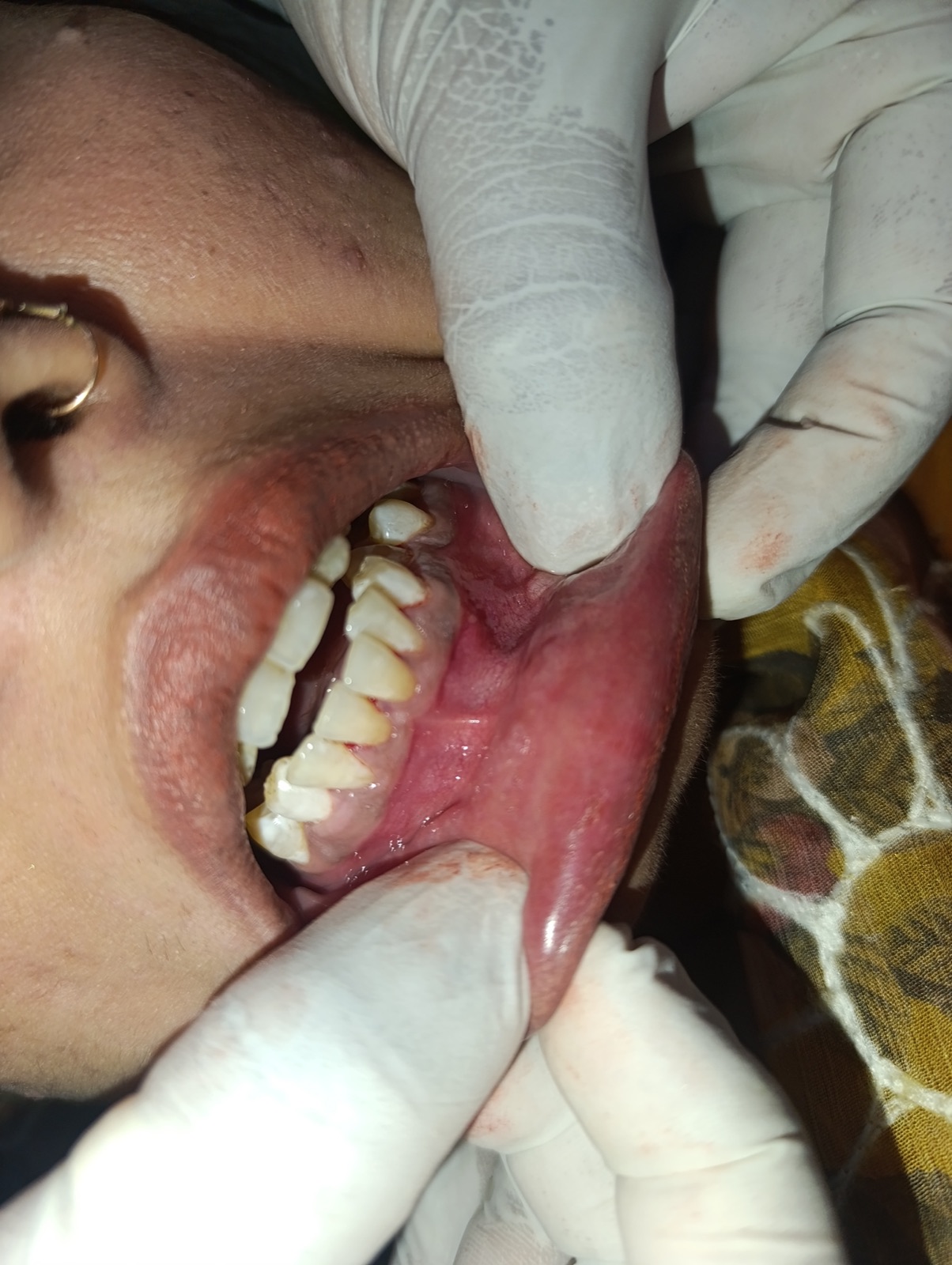
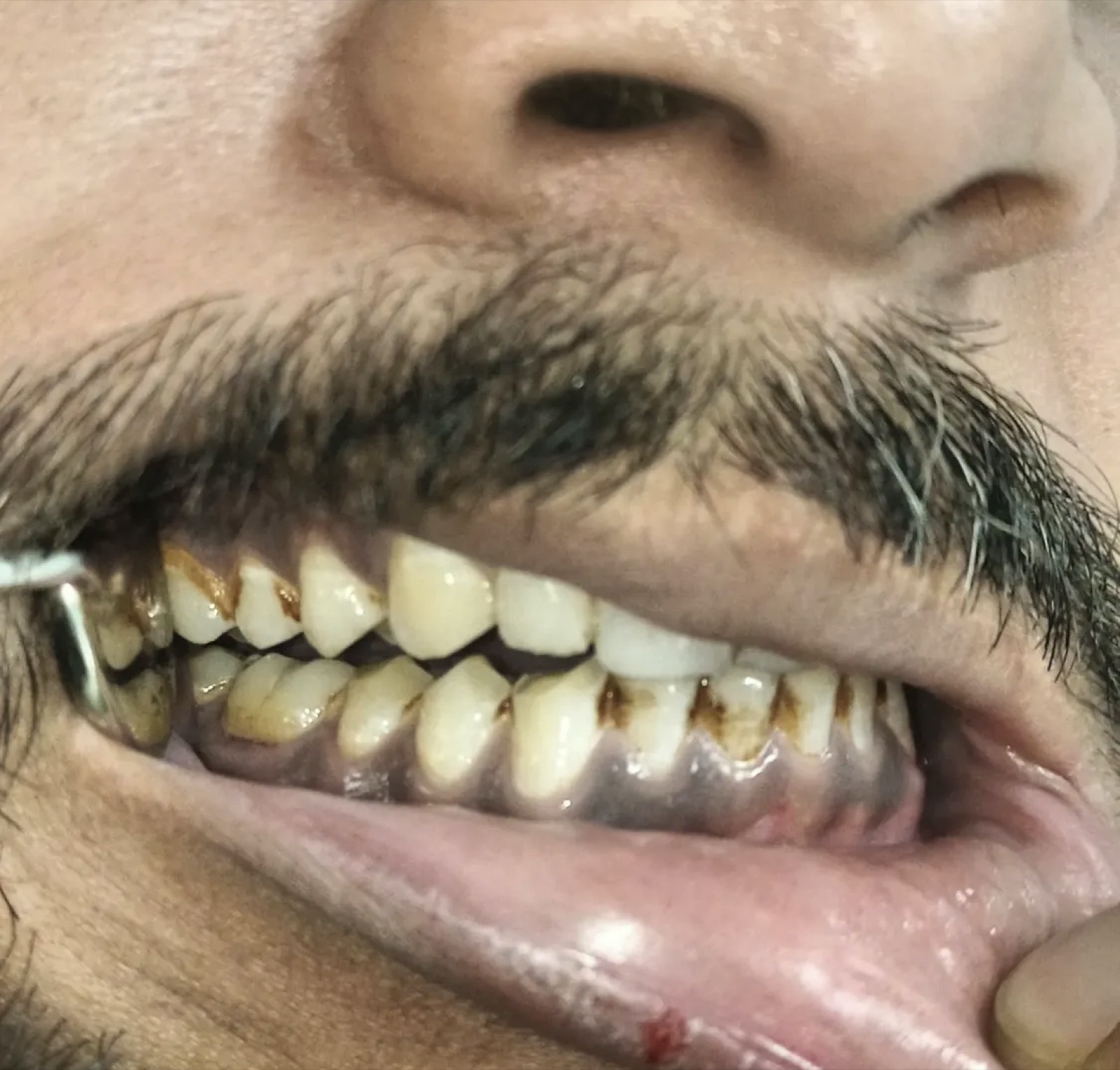 Before
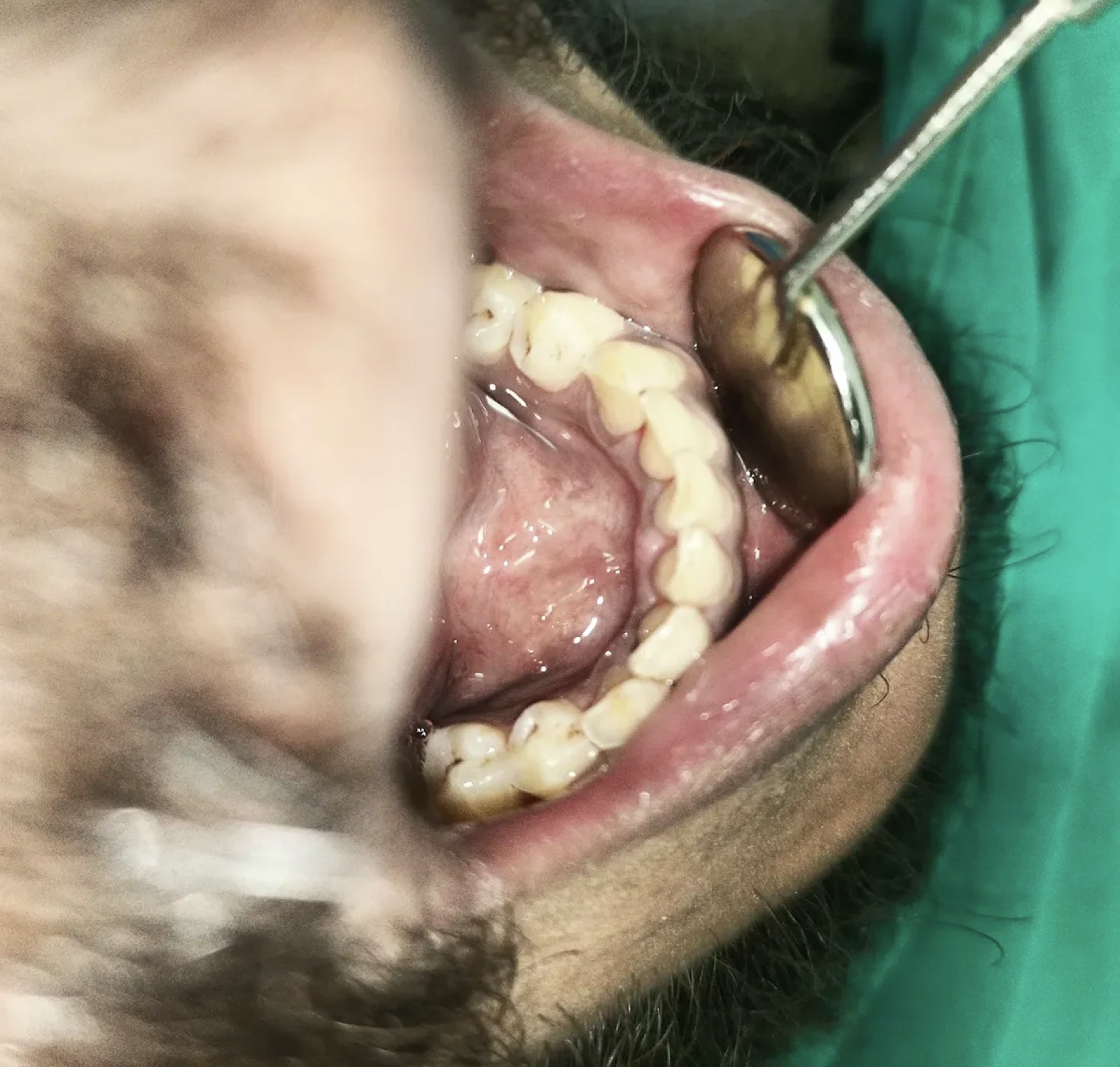 After
AfterThe bleeding had stopped surprising him.
Most patients we see at this stage of staining are not sick people. They are busy professionals who postponed a 45-minute appointment for years. Mr. Nawaz is one of them.
Mr. Nawaz is an advocate. He drinks five cups of tea a day, mostly between hearings, mostly with two spoons of sugar. He is forty years old. He brushes twice a day, with toothpaste, like most people. The last time he had seen a dentist before walking into our clinic was four years ago, for a small filling that he never went back to follow up on.
None of this is unusual for a Lahore professional in his bracket. The pattern we see again and again is the same: regular brushing at home, no professional cleaning for years, heavy chai, occasional paan, and a slow accumulation of staining that the patient stops noticing because the change happens a little bit at a time. By the time someone like Mr. Nawaz looks in the mirror and decides something needs to be done, the stain has been there for so long that the patient is convinced it must be permanent.
What finally brought him in was not the stain itself. He had grown used to that. It was a quiet moment during a client meeting when a junior associate slid a packet of mint across the table without saying anything. He realised the bad breath he had been worrying about privately had become visible to people around him. The next morning he searched on his phone and called us.
The first appointment ran an hour. We took six standardised photographs from the same angles we use for every patient. We measured the gum at six points around every tooth — a process we call charting. We reviewed his X-rays carefully and explained what we were seeing on the screen. Then we sat back and walked him through the good news first.
No cavities. No bone loss. No deeper periodontal involvement. The tooth structure underneath all the stain was perfectly intact. Despite the dramatic look from outside, what he had was a textbook case of generalised stain plus the early form of gum inflammation we call gingivitis — both of which are reversible with a single thorough cleaning.
We told him this might be the easiest dental visit of his life. He looked sceptical. We made the appointment for that Friday, which was the only day he could do, and asked him to bring a clean shirt in case he wanted to go straight back to chambers afterwards.
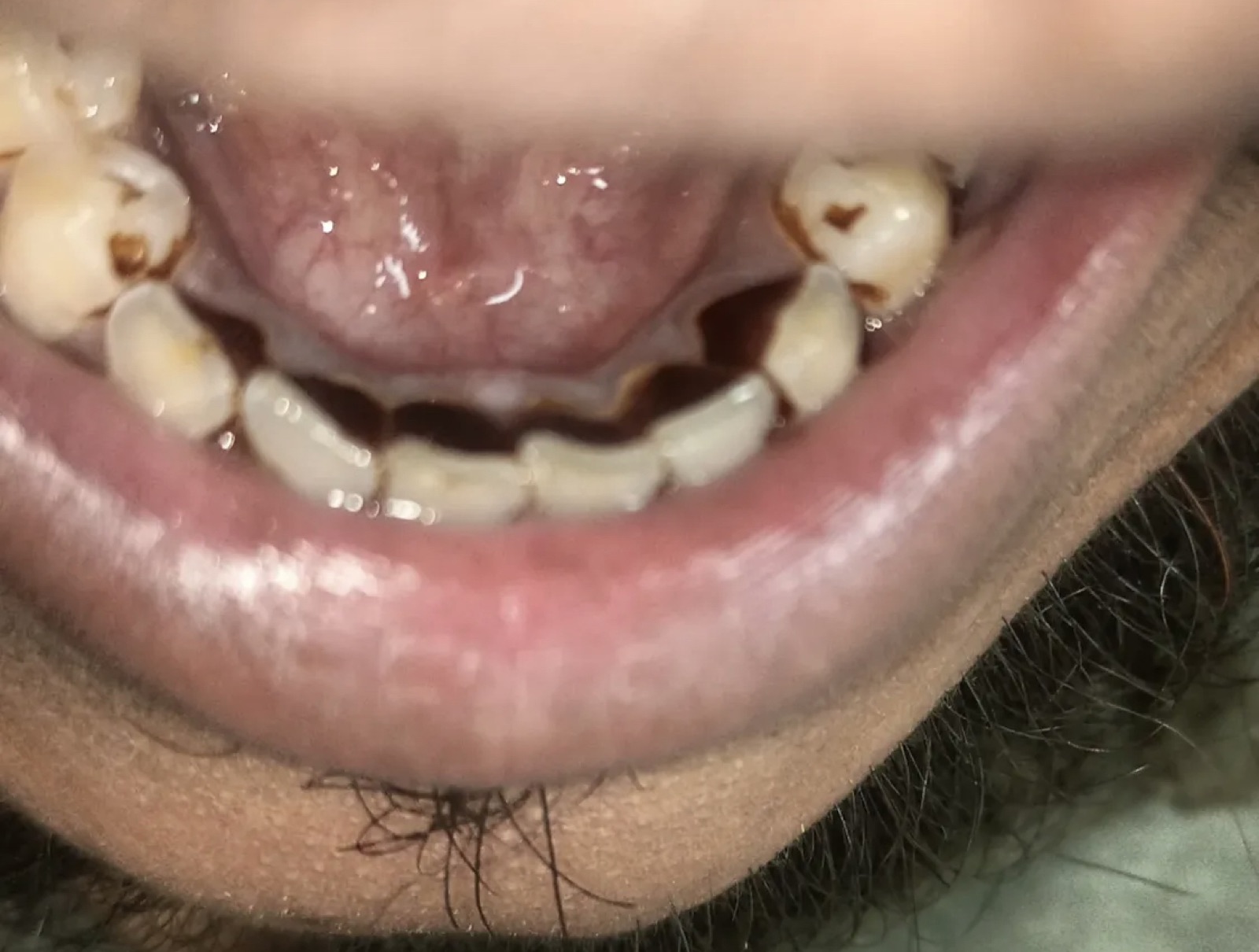
Four things — explained in plain English.
Most patients are nervous that something serious will be discovered. We always start with what we've ruled out, then walk through what we did find — without scary words and with a clear plan for each.
A decade of tea stains
Years of strong chai had left a dark, sticky film along his gum line and between every tooth. Tea contains tannins — natural compounds that bind tightly to enamel and slowly turn the surface yellow, then brown, then almost black. This kind of stain cannot be brushed off with toothpaste at home. It needs to be lifted off professionally with an ultrasonic scaler and a fine polishing paste. The good news for Mr. Nawaz: the enamel underneath was perfectly healthy. The stain was sitting on top of clean tooth structure.
Bleeding gums in 4 of 6 areas
When we tested his gums at six points around every tooth, four of the six areas of his mouth bled within seconds. This sounds alarming — it almost never is. Bleeding gums at this stage almost always mean the gum is irritated by plaque sitting along the tooth, not that something is decaying or infected deeper down. It is reversible. The fix is to remove the plaque the gum is reacting to, and the gum then calms down within seven to ten days.
Bad breath — and where it came from
Halitosis from his mouth was the symptom that finally brought him in. The bad smell was not coming from his stomach or sinuses. It was coming from bacteria that live underneath tartar and on the back of the tongue. They produce sulphur compounds — the same family of chemicals that make rotten eggs smell. The moment the tartar and tongue coating are removed, the smell disappears with them. No mouthwash can do this. Mouthwash masks the smell for an hour. Scaling removes the source.
No cavities. No bone loss.
This was the most important part of the consultation. We took two X-rays and looked carefully at the bone level around every tooth. The bone was intact. We checked every chewing surface for soft spots, dark pits, or hidden decay. None. So although the mouth looked dramatic from the outside, the underlying tooth structure was completely fine. He did not need fillings. He did not need root canals. He did not need any deeper periodontal work. A single thorough cleaning was enough.
Four steps. All in one sitting.
Every step was explained before it happened. He could see what we were doing in a small mirror at any point. There was no rush.
A quick check-up
We took six standardised photographs of his teeth so we could compare the after-photos to the same angles. We measured the gums at six points around every tooth — that takes about three minutes. We talked through what we were seeing on the X-ray. He could see the screen. Nothing was hidden from him.
~ 8 minA gentle numbing gel
Most patients do not need any anaesthesia at all for a routine scale. For Mr. Nawaz, the band of stain on the front-bottom teeth was thick enough that we used a topical numbing gel, brushed on with a cotton bud. No injection. He felt a slight buzzing sensation when the scaler touched those teeth, never a sharp pain.
~ 4 minCleaning, four corners
A small ultrasonic tip with a continuous water spray vibrates at a frequency that lifts tartar off in tiny layers. We work in the same order every time — upper right, upper left, lower left, lower right. The water keeps the tooth cool and washes the loosened debris away. After fifteen minutes, the visual difference was already obvious to him in the small mirror we hold up between phases.
~ 25 minPolish & a written aftercare plan
A fine, low-abrasive paste applied with a slow rubber cup polishes the enamel back to its natural shine. Tongue cleaned in the same step. Then we sat down for ten minutes and went through brushing technique, what to do after a cup of tea, and the small spacing brush we wanted him to start using between his lower front teeth. He left with a printed sheet and our WhatsApp.
~ 8 min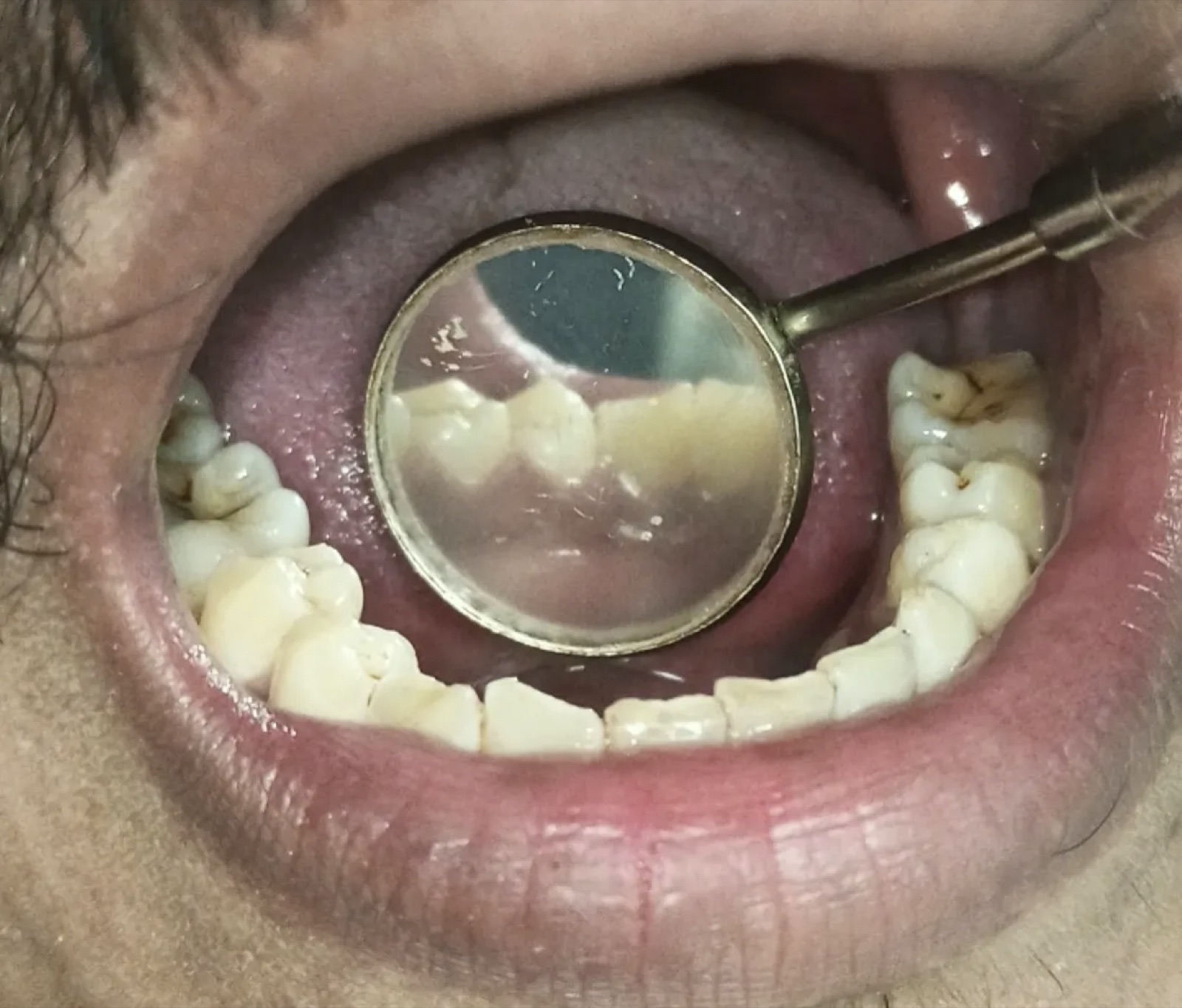 During — phase 3
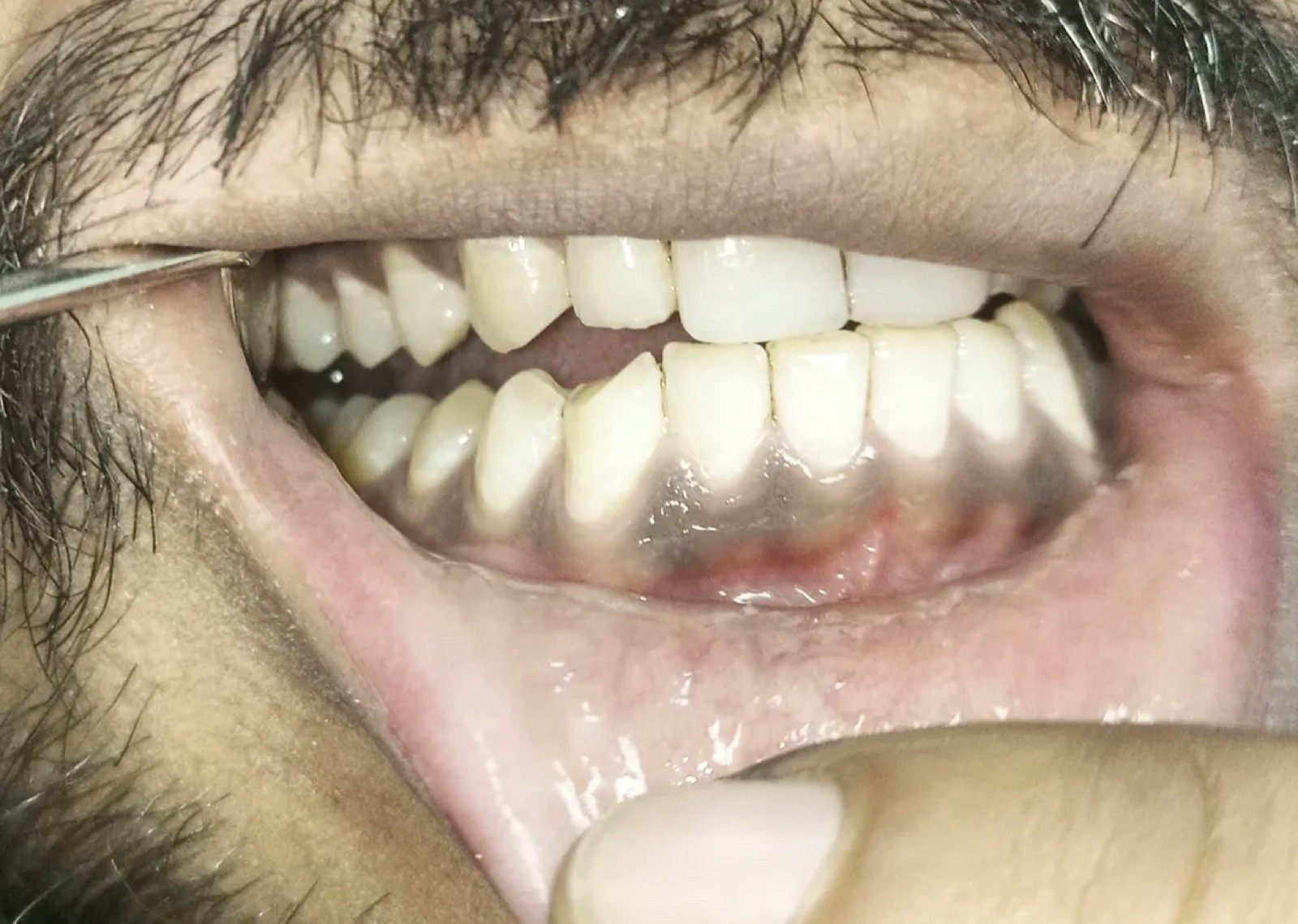 After — final polish
Same patient. Same chair. Same day.
Drag the divider across the photo to compare. Both photos were taken with the same camera and lighting inside our Lahore clinic — "before" right as he sat down, "after" before he stood up.
BeforeAfterWhy a toothbrush cannot do this.
Patients often ask, reasonably, why brushing for years did not prevent this from building up. The honest answer has three parts. None of them are your fault.
Plaque becomes tartar in 24 to 48 hours
Plaque is the soft, sticky film of bacteria that forms on every tooth, every day. Brushing removes most of it. But anywhere your brush misses — usually behind the lower front teeth, or in the back corners of the upper molars — the saliva mineralises that plaque into tartar within one or two days. Tartar is rock-hard. Once it forms, no toothbrush in the world will remove it. That is what the ultrasonic scaler is for.
Tea pigments stain enamel below the surface
Tannin molecules in tea are small enough to slip into the microscopic pits of enamel. Once inside, they bond chemically. A toothbrush cleans the outer surface. It cannot reach pigments that have travelled inside the enamel. A polishing paste with a slightly larger particle size — applied professionally, briefly, under controlled pressure — does reach them and lifts them out without damaging the surface.
Bacteria under tartar produce smell
Underneath tartar — and on the back of the tongue — colonies of anaerobic bacteria break down proteins and produce volatile sulphur compounds. These are the chemicals that make breath smell. Mouthwash kills surface bacteria for an hour. To stop the smell at the source, you have to remove the shelter the bacteria are living in. That is exactly what scaling does.
Five questions our patients always ask.
These are the worries we hear most often, in the words our patients use. Tap any one to read the long answer.
Will scaling weaken my teeth or make them more sensitive forever?+
This is the single most common worry we hear, and the honest answer is: no — but you may feel mildly sensitive for the first one to three days, and we'll explain why so it doesn't surprise you.
Tartar acts like an insulator over the tooth. When we remove it, the enamel underneath is exposed to cold air and cold drinks again, sometimes for the first time in years. That sensation registers as sensitivity for 24–72 hours. Using a sensitive toothpaste like Sensodyne for one week handles it almost completely. After that, the sensitivity is gone — and the tooth is structurally stronger because the underlying surface is now clean and able to absorb fluoride from your toothpaste again.
The myth that scaling makes teeth loose comes from one specific situation: when calculus has been holding loose teeth in place for years and is suddenly removed, the looseness becomes obvious. The scaling did not cause it. The gum disease underneath did.
Why did I see gaps between my teeth right after the cleaning?+
Those gaps were always there. Tartar was filling them in, almost like cement between bricks.
When we remove the tartar, the original spacing — the spacing your teeth actually have — becomes visible again. Mr. Nawaz had a small gap between two of his lower front teeth that had been hidden for years. He noticed it on day one, was a little surprised, and by day three had stopped thinking about it.
Hiding gaps with tartar is the wrong way to keep them hidden. Tartar above the gum line is followed by tartar below the gum line, which is followed by gum disease, which is followed by actual bone loss. That progression takes years — but it is the path. Cleaning is the way out of it.
How painful is the scaling itself? Will I need an injection?+
For routine scaling — which is what Mr. Nawaz had — most patients do not need any anaesthesia at all. The ultrasonic tip vibrates at a high frequency and runs cool water over the tooth at the same time. The sensation is best described as a buzzing or a tickle, and a slight pressure where the tartar is being lifted off.
Where patients sometimes feel a sharper sensation is at the gum line on the lower front teeth, because that area has the most concentrated nerve endings and is also where the heaviest tartar usually sits. For those specific areas we apply a topical numbing gel — a cotton bud, no injection — which dulls the sensation completely.
If a patient has very deep deposits below the gum line, we may use a single small local anaesthetic injection. This applies to roughly one in twenty cases. Mr. Nawaz did not need it.
Will the stains come back? How long does the result last?+
Yes — slowly — if you do nothing. No — for years — if you change one or two small habits.
Tea, coffee, paan, and tobacco are the main culprits in our patient population. The stain lays down a microscopic film every time you drink them. Brushing removes most of it within 24 hours. The stain you see on a tooth six months later is what brushing missed and what the saliva later mineralised into tartar.
The single most useful habit to add is a five-second water rinse after every cup of tea. That is not optional advice — it is the difference between coming back for a clean every six months and coming back twice as often.
We re-photograph every patient at six months and again at twelve. You can see your own trend on a printed sheet, and we adjust the recall interval if your habits or your stain pattern change.
How much does this cost? Are there hidden charges?+
A standard scaling and polishing at Odonto is PKR 4,500, all-inclusive. That covers the full chart, the X-rays if we need any, the scaling itself, the air-flow stain lift, the polish, the tongue clean, and the printed aftercare sheet you take home.
There is no extra charge for the consultation, no charge for the photographs, and no charge for the topical anaesthetic gel. If we discover during the cleaning that you actually need deeper work — root planing per quadrant, for example — we will stop, show you the X-ray, explain why, and write a separate quote before we proceed. Nothing happens without your sign-off.
Mr. Nawaz paid PKR 4,500. There were no add-ons. His next six-monthly visit will be the same fee.
The follow-up visits.
One scaling is not the end of a case — it is the beginning of a maintenance cycle. Every patient at our clinic gets the same follow-up structure: a quick review at one week, a comparison at six months, and a full repeat appointment at twelve months. Here's how Mr. Nawaz's went.
He came in for a ten-minute review at one week. We measured the gums again at the same six points around every tooth. Bleeding had reduced from four sextants down to one — a single spot on the lower-right molar — which we showed him how to focus on with the interdental brush. Photographs retaken so we had a clean baseline going forward.
Mr. Nawaz messaged on WhatsApp at the four-week mark. He had switched to a soft brush that same week. He had started rinsing with water after every cup of tea. He had begun using the small interdental brush in the lower front teeth nightly. He was not whitening at home — we had asked him to wait at least a month and he had listened.
He returned in September for the six-month recall. Mild stain re-accumulation was visible at the cervical band of the lower anteriors — entirely expected for a patient who drinks five cups of tea a day. Routine scaling and polishing performed in 25 minutes. No new gingival inflammation. Same six photographs taken so we could compare against March. He paid PKR 4,500 again. We have his next visit on the calendar for March 2026.
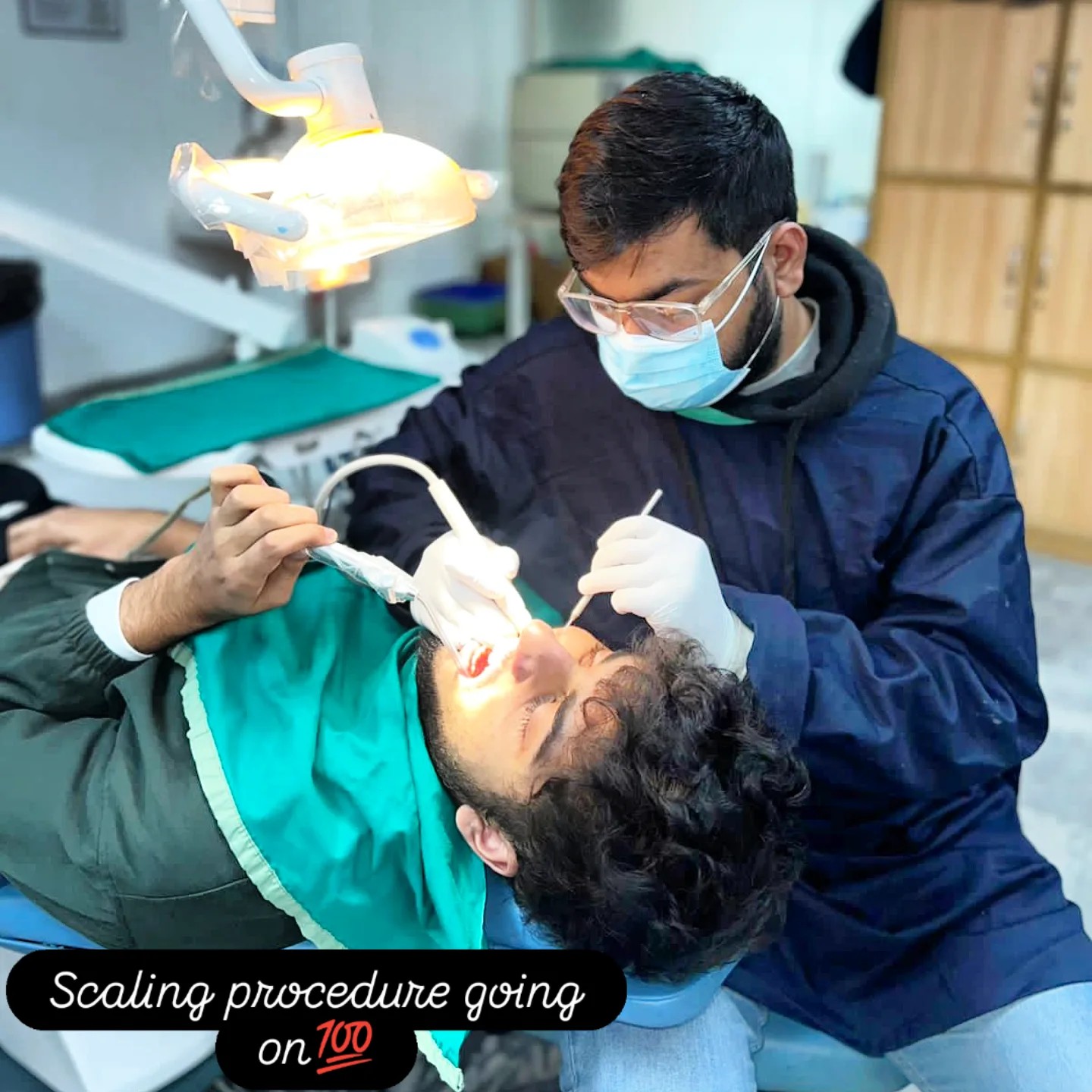
Dr. Mian Momin Ahmad
“Most of the patients I see at this stage of staining are not sick people. They are busy professionals who postponed a 45-minute appointment for four years. We do not lecture. We clean the teeth, show the difference in a mirror at every step, and give a clear plan in writing for keeping it that way. Every patient who walks out of my chair leaves with the same six-month recall on the calendar — that single habit, more than anything we do in the chair, decides whether the result holds for ten years or comes undone in twelve months.”
Six small habits that hold the result.
A clean is not the end of the story. The teeth stay this way only if a few small things are done at home. These six are the only ones we asked Mr. Nawaz to commit to — none of them require buying anything expensive.
Brush twice a day, gently
Soft-bristled brush. Small circles. Two minutes total. Hard scrubbing actually wears the gum away over years and exposes the root surface, which is yellower and more sensitive than enamel. We sized Mr. Nawaz up for an Oral-B sensitive brush and asked him to switch to it that week.
Rinse with water after every cup of chai
A five-second rinse with plain water after tea or coffee removes most of the pigment that would otherwise sit on the teeth and harden into stain by the next morning. He drinks five cups a day. Five rinses a day. That single habit, more than anything else, decides whether the staining returns in three months or fifteen.
Floss or use an interdental brush daily
The space between teeth is where most stain and decay starts because a brush bristle cannot reach there. For tight contacts, dental floss works fine. For the wider gaps in his lower front teeth, a small interdental brush (TePe size 2) reaches every surface in two seconds. Once a day is enough — most patients do it standing in front of the bathroom mirror after dinner.
Treat gum bleeding as a signal, not a punishment
Many patients see bleeding when they brush, get scared, and start brushing less. This is the opposite of what works. The bleeding is telling you the gum at that spot is irritated and needs more — gentle — cleaning, not less. After his scaling, we asked him to brush firmly enough that the gum bleeds for about five days. After that, the gum heals and stops bleeding for years.
Skip whitening toothpaste — at least for now
Most "whitening" toothpastes are mildly abrasive — they work by sanding off surface stain. Right after a professional scaling, the enamel is at its smoothest. Using an abrasive paste at that point causes more harm than good. We asked him to use a regular fluoride toothpaste (Sensodyne Sensitive or Colgate Total) for at least a month before considering anything else.
Come back at six months
Tartar reforms slowly. For most patients, six months is the right interval — long enough that home care is meaningfully tested, short enough that nothing severe accumulates. Each follow-up clean takes 25 minutes, costs PKR 4,500, and we take the same six photographs so you can see the trend year over year. We have his next visit on the calendar already.
Mr. Nawaz waited four years. Most of our patients wait longer.
We do not lecture about postponement. The reasons we hear are real — meetings that ran long, hearings that piled up, a fear of finding out something serious, the assumption that a cleaning is going to be expensive or painful. None of those are stupid. They are why we are still able to take walk-ins on most weekdays.
What waiting another year actually does, in plain terms:
None of that is a scare tactic. It is the timeline we see, in our chair, in this clinic, every week. The fix at this stage is still a single 45-minute visit. The fix in five years is rarely as simple.
More on scaling, and the conditions behind it.
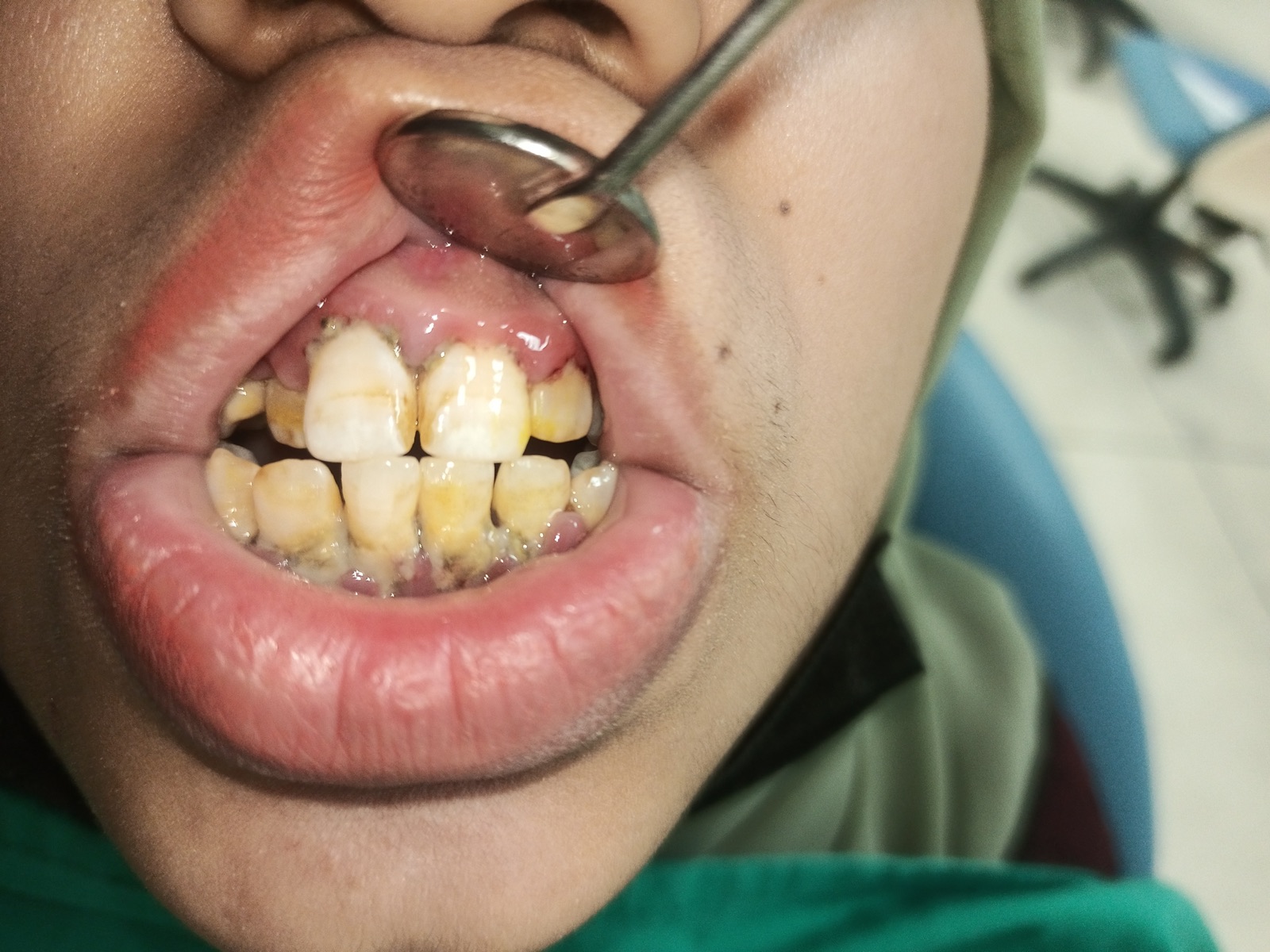
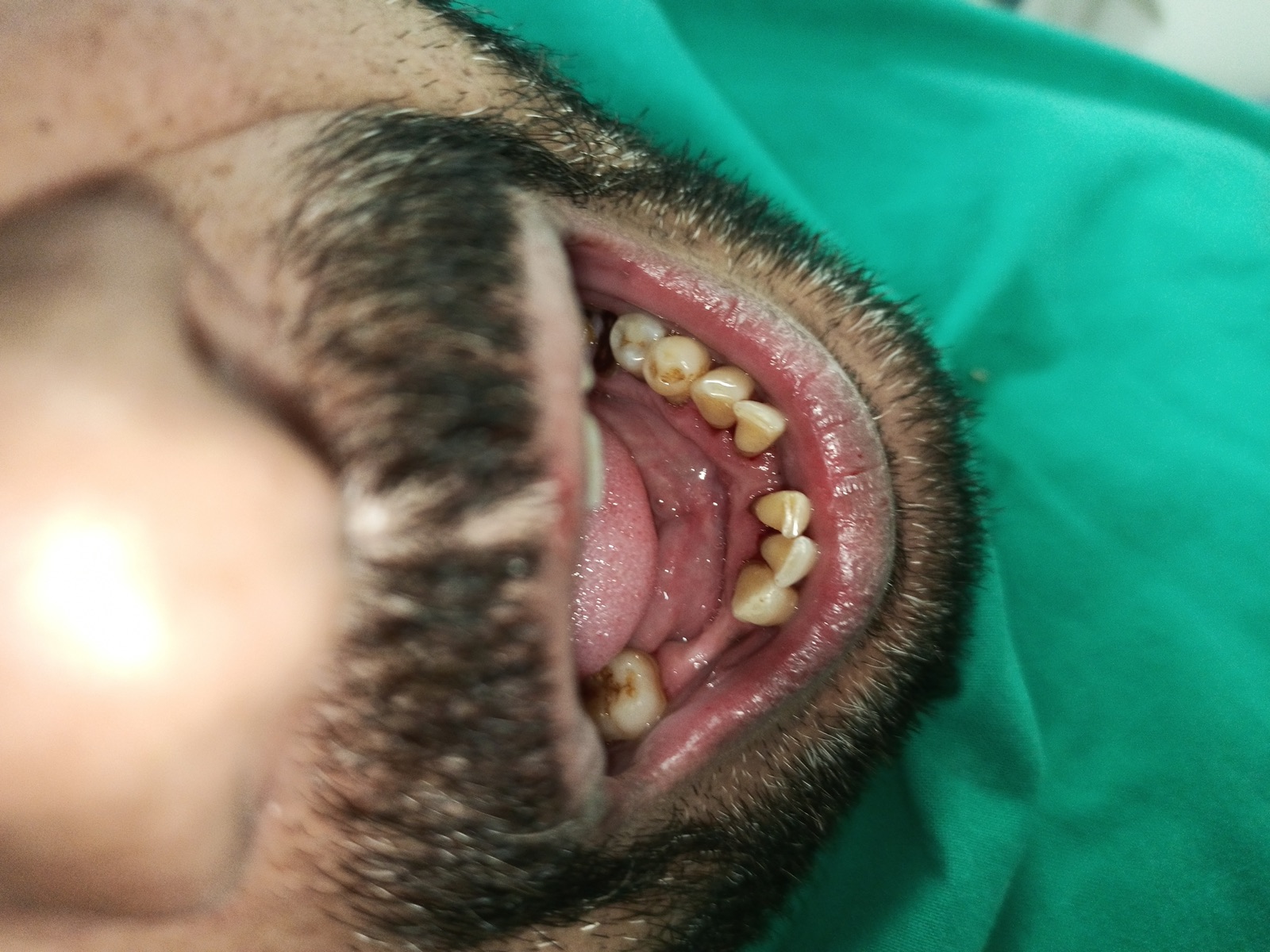
Three more patients like Mr. Nawaz.
Every case in this archive is a real Odonto patient with their consent. Names are accurate where the patient was happy to share them, age ranges are real, and every photograph was taken in our Engineers Town clinic.
Want a result like Mr. Nawaz's?
The first 15 minutes are free. We will examine your teeth, take any photos needed, and put a written quote in your hand. There is no pressure to book the cleaning the same day, and there are no hidden charges if you do.